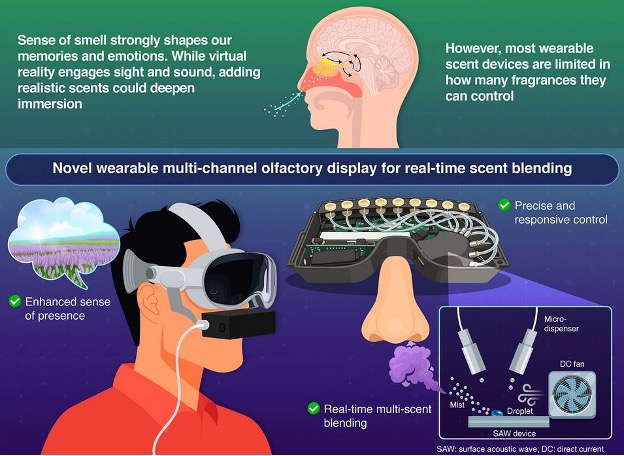
The smell sense has not been as accurately reproduced in virtual reality (VR) technology, despite numerous advancements that provide realistic visual and audio material that immerses the user in the surroundings.
The first film to use the catchy-sounding Smell-O-Vision system was Scent of Mystery (1939), which let audiences experience aromas that were emitted from behind their seats and timed with particular sequences. It made use of a compressed air-powered, manually operated device known as the Smell Brain. Unfortunately, there were conflicting reactions from the audience due to its loudness and unequal aroma dispersal in the theater, reports New Atlas.
Subsequent gaming devices have continued to be rather heavy and difficult to incorporate into wearable virtual reality systems.
However, a group led by Kelvin Cheng from Rakuten Institute of Technology, engineering doctorate student Zhe Zou from Science Tokyo, and Professor Takamichi Nakamoto from Institute of Science Tokyo has recently developed a wearable gadget that is more compact and better compatible with existing configurations.
"We created a small-sized scent generation system that can be worn together with a VR device, so a user can experience scents that match the virtual environments as they explore, and a single user can use it at the same time," explains Nakamoto.
Related Lightweight AR Glasses with Theater-Like Immersion
In addition to improving the techniques for delivering and regulating the perfumes, the study team was able to minimize the driver circuit, which is the part that regulates the apparatus. In order to coordinate in real time with the VR display, the device can combine many fragrances. To replicate a variety of aromas, up to eight distinct fragrance components can be mixed simultaneously in varied proportions.
The scientists atomized the tiny liquid scent droplets into a thin mist using ultrasonic waves and a micro-dispenser. The fragrance delivery is precisely controlled using an electro-osmotic pump, a device that uses electrical force to disseminate liquids, guaranteeing consistent aroma creation with little timing gaps.
"We also created virtual travel content using these devices, so that users could visit various virtual locations and experience the scent at those places for a realistic travel experience," adds Nakamoto.
Test participants reported the added scents made the virtual environment feel more realistic and improved the feel of being present in a virtual reality environment.