High blood pressure, or hypertension, is one of the world's most widespread health problems. Often called the "silent killer," it affects more than one billion people worldwide. What makes the condition particularly dangerous is that many people have no noticeable symptoms and remain unaware of their elevated blood pressure for years. This is especially concerning among adults aged 18 to 44, as delayed diagnosis can increase the risk of serious complications, including stroke, heart failure and other cardiovascular diseases.
Regular blood pressure checks remain essential for identifying hypertension. However, traditional screening usually takes place during occasional medical appointments, meaning many cases go undetected. Wearable technology could offer another way to identify people who may be at risk, according to a Google research.
A new study published in Nature introduces an artificial intelligence (AI) system that uses data from an ordinary smartwatch to detect signs of persistent hypertension. Developed by researchers from Google Research, Beth Israel Deaconess Medical Center and Harvard Medical School, the system is called AI-PPG-ACC-HTN. Unlike many existing cuffless blood pressure technologies, it does not require calibration with a traditional arm cuff.
The findings suggest that smartwatch sensors could eventually support early hypertension screening and help identify people who need further medical evaluation.
How the smartwatch technology works
Rather than attempting to calculate exact systolic and diastolic blood pressure readings at a particular moment, the AI system looks for physiological patterns associated with sustained hypertension. This approach helps reduce the influence of temporary factors such as movement, temperature changes and other environmental conditions.
The technology uses information from two sensors commonly found in modern smartwatches.
Read more Will Smart Wearables Revolutionize Clinical Trials?
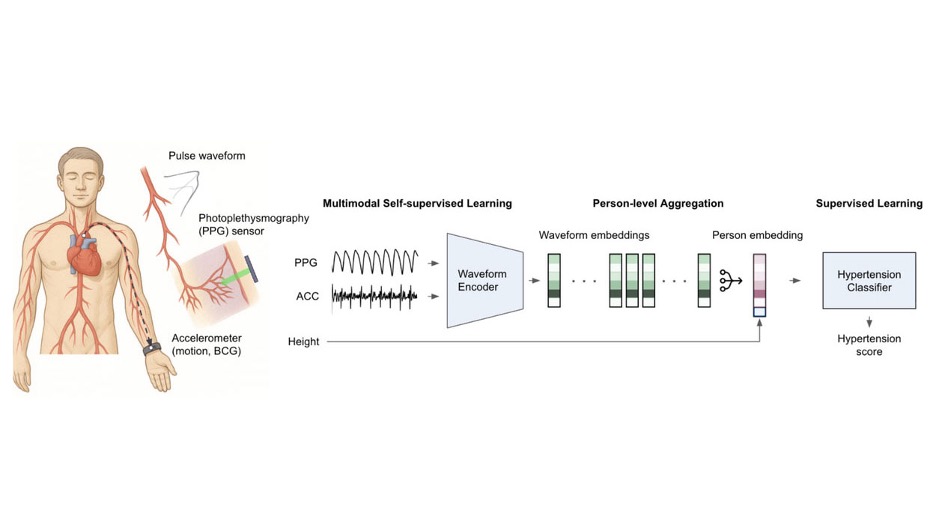
Photoplethysmography (PPG): This optical sensor uses light to detect changes in blood volume beneath the skin. By examining the resulting pulse waveforms, the system can identify patterns associated with cardiovascular function.
Accelerometry (ACC): This motion sensor detects movement and subtle mechanical vibrations generated by the heartbeat. These vibrations, known as ballistocardiographic signals, provide additional information about the heart's pumping activity.
The AI system combines signals from both sensors to develop a picture of an individual's cardiovascular patterns over several days.
Its development involved two stages of machine learning. First, researchers trained a deep neural network using 492,347 hours of smartwatch sensor recordings collected from 2,109 participants. The model learned to recognize patterns in the signals without requiring manually labelled medical data.
In the second stage, the system combined information gathered over multiple days with the individual's height to calculate a probability score indicating the likelihood of hypertension.
Clinical testing and results
To assess its performance, researchers conducted a prospective clinical study involving 196 participants across five medical centers in the United States. Participants had no known cardiovascular disease and were not taking blood pressure medication.
The smartwatch system was compared against 24-hour ambulatory blood pressure monitoring (ABPM), widely regarded as the clinical reference standard for diagnosing hypertension.
Researchers examined two situations: initial screening and confirmatory testing.
Initial screening: The smartwatch system achieved 65.8% sensitivity and 90% specificity, with a positive predictive value (PPV) of 80.6%. By comparison, conventional office-based screening had 55.3% sensitivity and a PPV of 77.8%.
These results suggest that the smartwatch approach could identify a meaningful proportion of people with hypertension while producing relatively few false-positive results.
Confirmatory testing: Researchers also examined 48 participants whose initial office blood pressure readings were elevated. In this group, the smartwatch achieved 78.4% sensitivity, 90.9% specificity and a PPV of 96.7%.
Traditional follow-up office measurements produced lower results, with 67.6% sensitivity, 63.6% specificity and an 86.2% PPV. Multi-day home monitoring achieved 89.2% sensitivity, 81.8% specificity and 94.3% PPV.
Although the smartwatch performed well in several measures, its results do not establish that it can replace conventional diagnostic methods.
What the AI detected in the signals
Researchers also investigated which physiological patterns influenced the system's predictions.
People with higher predicted hypertension risk tended to show narrower pulse waveforms, slower initial pulse increases and differences in reflected blood waves. These patterns may be associated with increased arterial stiffness.
The accelerometer data revealed differences in subtle heart-generated vibrations. In particular, researchers observed deeper K waves and wider IJK complexes among participants with higher predicted risk scores.
These findings provide insight into how changes in blood vessels and cardiac activity may be reflected in signals collected from the wrist.
What this means for the future
The research highlights the potential of consumer wearables to make hypertension screening more accessible. Because smartwatches can collect physiological information during everyday activities, they may eventually help identify people who would otherwise go years without discovering that their blood pressure is elevated.
However, the technology remains experimental. It is not intended to replace traditional blood pressure monitors, medical examinations or 24-hour monitoring. Anyone identified as potentially at risk would still need proper clinical assessment.
The research also does not establish an existing or forthcoming commercial product feature.
Nevertheless, the findings represent an encouraging development in preventive healthcare. By using everyday wearable technology to recognize possible warning signs, AI could help close the hypertension awareness gap and encourage earlier medical intervention before serious cardiovascular complications develop.