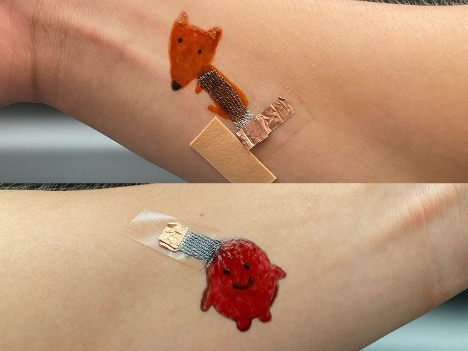
Penn State engineers are fusing science and art to produce cute, paint-on tattoos that have the potential to power robotic limbs, monitor brain waves, and detect heart attacks early. The system is colorful, personalized, and readily washable.
The team has created a conductive ink that can power sensors and be applied straight to a person's skin in whatever design they can think of, and they have filed a provisional patent for it. They are not only more fashionable than existing wearable sensor designs, but they are also more sensitive, robust, and accurate since the ink, which can be colored with any desired color, employs materials that connect better with the skin. The findings were described in a report that was published in the Proceedings of the National Academy of Sciences.
According to Larry Cheng, corresponding author on the paper and James L. Henderson Jr. Memorial Professor of Engineering Science and Mechanics at Penn State, wearable healthcare systems are powered by electrode contacts affixed to the body.
Conventional electrode designs use stiff, metal-based materials that provide stability but have trouble adhering to the body during exercise or movement. Hydrogel, a soft, jelly-like substance that can absorb and swell with water to stretch and better mimic the body's movement, is used in many experimental designs, such as the ones Cheng has been studying for more than ten years. However, over time, this substance may dry, which would result in the electrodes losing their stretchiness and adherence, reports Ty Tkacik in Penn State.
Wanqing Zhang, an engineering science and mechanics doctoral candidate and first author on the paper, explained that it’s not just the electrodes peeling off that contributes to less accurate sensor readings, but the actual act of applying them. Many commercial sensors have trouble accurately recording what is happening inside a patient's body, especially when applied to hairy or sweaty skin.
The team mixed several different types of polymers, or plastics, and acidic additives into a water-based solution to create the ink. It has the consistency of glue when wet but can dry onto the skin in less than 10 minutes, Zhang said. Drying can be accelerated with the help of a hair dryer.
“The ink itself almost behaves like face paint,” Cheng explained. “It starts out almost transparent, but you can use food dye to pigment the ink into whatever colors you need to paint whatever design you have in mind — like a cartoon or Superman. This allows us to completely personalize the wearable to a person’s preference."
Related Wearable Sticker Can Identify Real Human Emotions
The team revealed that its electrode-powered sensors are highly responsive and adjustable. According to Zhang, applying the material directly to the skin improves measurements since it better adapts to the texture of the skin. A connecting area of the electrodes is painted onto a porous, silver cloth that resembles metal fabric and is applied to the skin in order to improve the stability between the electrodes and the sensors they inform. Before solidifying and adhering to the skin's surface, the wet ink seeps into the fabric. The larger electric module, which is glued to the wearer's skin beneath their clothing, has the connected part hooked into a port. This larger module uses Bluetooth to wirelessly send the electrical impulses that the ink has collected to a computer.
In addition to more evenly adhering to the texture of the skin and efficiently recording electrical signals, the electrodes may expand to more than 150% of their original size without breaking because to the textile's porosity composition.
In one experiment, the team demonstrated that the painted electrodes could successfully track a co-author's ECG readings over a 12-hour period of daily activities. In another test, a different co-author tracked their readings during an exercise routine, demonstrating that the electrodes maintain adhesion and accuracy even during physical activity. In a different test, the scientists monitored a co-author's forearm EMG signals and sent them to a robotic prosthetic, allowing the person to operate the robotic hand without coming into contact with it.
This work was supported by the U.S. National Science Foundation and the National Institutes of Health.