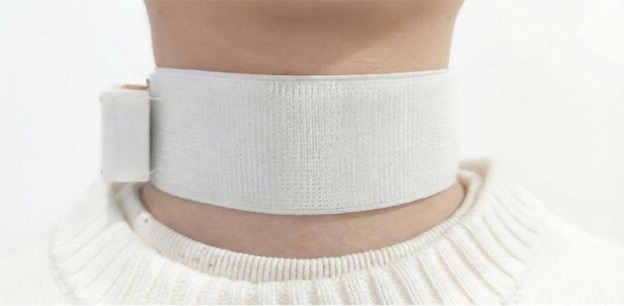
A new washable device worn around the neck has restored voice to stroke sufferers.
Revoice is a technology developed by researchers at the University of Cambridge that may eliminate the need for invasive brain implants and allow patients to speak organically.
“When people have dysarthria following a stroke, it can be extremely frustrating for them, because they know exactly what they want to say, but physically struggle to say it, because the signals between their brain and their throat have been scrambled by the stroke,” explains Prof. Luigi Occhipinti, one of the leaders of the research team.
Revoice is designed specifically to read and reconstruct these signals. Invasive treatments like brain implants are frequently not necessary because many people eventually regain their natural speech and just require temporary assistance. Revoice provides a wearable, non-invasive substitute, reports New Atlas.
The device has a wireless printed circuit board, textile strain sensors, and a soft, adjustable choker-like appearance. Two AI agents are used by its integrated AI system to decipher speech signals: one reconstructs words from quietly mouthed speech and anticipates phrases by sensing vibrations in the throat muscles, while the other measures the patient's neck pulse to determine their emotional state. This enables the device to rebuild entire sentences while still making them logical and emotionally compelling.
Read more New Brain Implant Decodes A Person's 'Inner Monologue'
Following a trial with healthy individuals, the wearable underwent some tuning before being tested on five stroke patients. The results showed remarkably low error rates of 2.9% for sentences and 4.2% for words. In one instance, a patient mouthed the words "We go hospital," which Revoice translated into “Even though it’s getting late, I’m still feeling uncomfortable. Can we go to the hospital now?” Participants indicated that the device allowed them to speak as fluently as they did prior to the stroke and reported a 55% increase in user satisfaction.
Revoice may benefit those with Parkinson's illness and motor neuron disease in addition to stroke victims, according to the researchers.
Revoice is useful for everyday usage because its fabric is washable, breathable, and long-lasting. With just one charge, the 1,800-mWh battery that powers it should last all day. The product will need to go through more thorough clinical trials before it can be sold. The study team intends to expand the variety of emotional expressions and add support for different languages if they are successful.
The study was published in the journal Nature Communications.