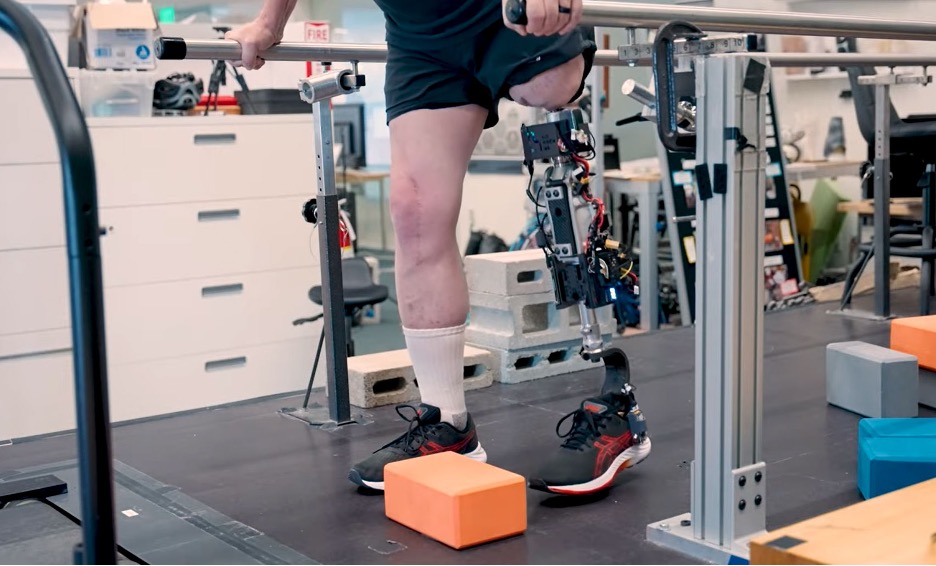
A new bionic knee created by MIT researchers can assist individuals who have had above-the-knee amputations move more quickly, climb stairs, and dodge obstacles more readily than they could with a conventional prosthesis.
The new system integrates directly with the user's bone and muscle tissue, unlike prostheses where the residual limb rests inside a socket. This allows for more stability and greatly increases the user's control over the prosthesis's movement, Anne Trafton reports MIT News.
Compared to those who had more conventional above-the-knee amputations, participants in a small clinical study also stated that the limb felt more like a part of their own body.
“A prosthesis that's tissue-integrated — anchored to the bone and directly controlled by the nervous system — is not merely a lifeless, separate device, but rather a system that is carefully integrated into human physiology, offering a greater level of prosthetic embodiment. It’s not simply a tool that the human employs, but rather an integral part of self,” says Hugh Herr, a professor of media arts and sciences, co-director of the K. Lisa Yang Center for Bionics at MIT, an associate member of MIT’s McGovern Institute for Brain Research, and the senior author of the new study.
Tony Shu PhD ’24 is the lead author of the paper, which appears today in Science.
Related Magnets Enhance Control of Prosthesis
According to a 2024 study, individuals who had below-the-knee amputations and underwent AMI surgery were able to walk more quickly and avoid obstacles far more naturally than those who had undergone conventional below-the-knee amputations.
To better assist those who have had amputations above the knee, the researchers expanded the methodology in the new study. In order to provide greater stability and improved sensory input, they aimed to develop a system that could be embedded into the bone in addition to employing AMI to read out signals from the muscles.
In order to accomplish that, the researchers devised a method for implanting a titanium rod into the remaining femur bone at the site of amputation. Compared to a conventional prosthesis, this implant offers superior mechanical control and load bearing. Furthermore, the implant has 16 wires that gather data from electrodes on the body's AMI muscles, allowing for more precise translation of the impulses originating from the muscles.
A novel robotic controller created especially for this investigation receives AMI signals from this bone-integrated device, called e-OPRA. The torque required to move the prosthesis in the manner the user desires is determined by the controller using this information.
In this study, two subjects received the combined AMI and e-OPRA system, known as an osseointegrated mechanoneural prosthesis (OMP). These users were compared with eight who had the AMI surgery but not the e-OPRA implant, and seven users who had neither AMI nor e-OPRA. All subjects took a turn at using an experimental powered knee prosthesis developed by the lab.
In addition to testing gait and other movements, the researchers also asked questions designed to evaluate participants’ sense of embodiment — that is, to what extent their prosthetic limb felt like a part of their own body.
Questions included whether the patients felt as if they had two legs, if they felt as if the prosthesis was part of their body, and if they felt in control of the prosthesis. Each question was designed to evaluate the participants’ feelings of agency, ownership of device, and body representation.
The researchers found that as the study went on, the two participants with the OMP showed much greater increases in their feelings of agency and ownership than the other subjects.
“Another reason this paper is significant is that it looks into these embodiment questions and it shows large improvements in that sensation of embodiment,” Herr says. “No matter how sophisticated you make the AI systems of a robotic prosthesis, it’s still going to feel like a tool to the user, like an external device. But with this tissue-integrated approach, when you ask the human user what is their body, the more it’s integrated, the more they’re going to say the prosthesis is actually part of self.”
The AMI procedure is now done routinely on patients with below-the-knee amputations at Brigham and Women’s Hospital, and Herr expects it will soon become the standard for above-the-knee amputations as well. The combined OMP system will need larger clinical trials to receive FDA approval for commercial use, which Herr expects may take about five years.
The research was funded by the Yang Tan Collective and DARPA.