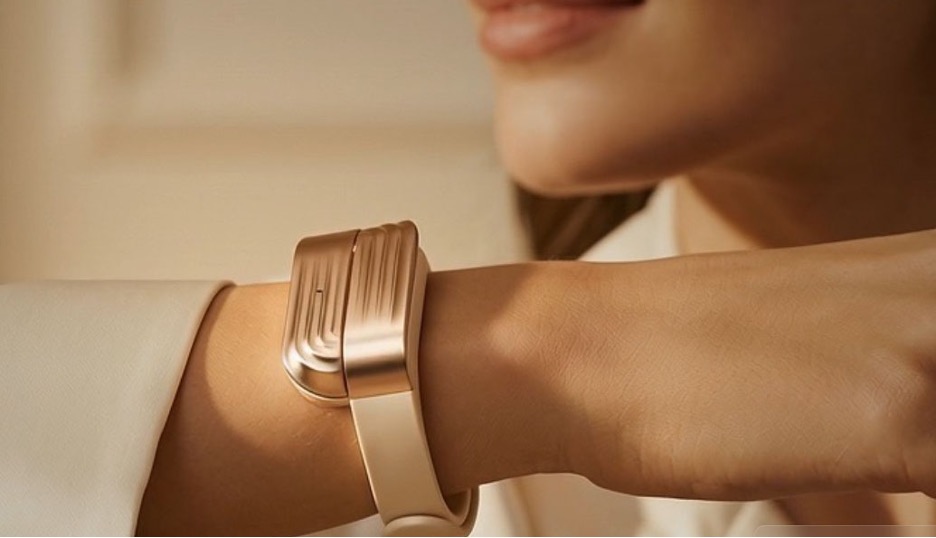
Clair, a new women's health firm, has emerged from stealth with ambitions to introduce a wearable that can be worn on the wrist and offers continuous, non-invasive insights into the hormone patterns of women.
Clair, which was founded by Stanford graduates Jenny Duan and Abhinav Agarwal, bills itself as the first wearable designed especially to measure hormonal dynamics in real time without the need for needles, blood draws, or urine testing. Instead of measuring hormones directly in blood, saliva, or perspiration, it characterizes the product as continuous hormone monitoring by physiological inference. According to the company, its technology uses a variety of physiological cues to determine changes in important reproductive hormones, such as follicle-stimulating hormone (FSH), luteinizing hormone (LH), progesterone, and estrogen, reports Future Fem Health.
Skin temperature, resting heart rate, heart rate variability, sleep architecture, breathing rate, electrodermal activity, and motion tracking are the ten biosensors that Clair utilizes to monitor hormonal changes. Throughout your cycle, these signals correspond to changes in progesterone and estrogen.
Clair is intended to fill a number of gaps in the healthcare system as it stands today. Women are still underrepresented in clinical trials and medical research, which results in a lack of data and a slower rate of advancement in our knowledge of women's health issues. Duan and Agarwal hope to bridge these gaps with Clair, a technology that offers ongoing, noninvasive hormone insights.
Related Wearable Patch Monitors Baby’s Movements in Utero
According to Bavan, hormone tracking can “provide insight into menstrual cycle patterns and can aid with both diagnosing and assessing treatment for [various] conditions.”
“[Clair enables] patients [to] gain insight into their personal hormone fluctuations over different time periods,” Bavan said, “and share this information at healthcare visits to better understand and correlate any medical issues they are facing and avoid repeat blood draws.”
Clair focuses on four primary uses:
• Fertility tracking: The majority of ovulation tests identify the spike in LH that occurs when your body tries to ovulate, but they are unable to verify if ovulation actually took place. Clair monitors the rise in progesterone after ovulation to verify the release of the egg. Notifications will be sent to you prior to the onset of your fertile window, not after it has passed.
• Hormonal health management: If you're tired after eight hours of sleep and your fitness tracker indicates that you're recovering "excellently," Clair can demonstrate that your weariness was caused by a nocturnal rise in progesterone. The effects of hormones on mood, energy, and sleep quality are demonstrated by continuous tracking, which identifies trends that snapshot testing overlooks.
• Athletic performance: By explaining why recovery seems more difficult in the luteal phase and high-intensity training may feel simpler in the late follicular phase, Clair can help you modify your program according to real physiology rather than conjecture.
• Support during the menopause and perimenopause: Clair will offer knowledge amid hormonal changes that typically leave women in the dark about their bodies.
In order to establish Clair as a legitimate medical device rather than just a lifestyle item, Duan and Agarwal intend to apply for FDA approval. The company intends to start a clinical trial at Stanford Medicine this spring as part of this endeavor.
Duan stressed how crucial it is to exercise initiative when attending college. "One of the best places to go out and try something new and choose a path that comes in line with your mission and vision for the world is Stanford," she said.