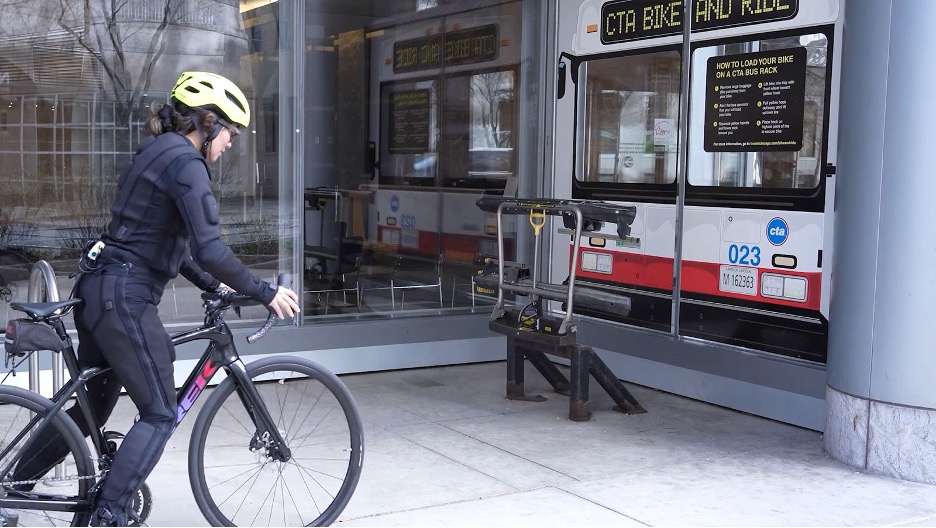
Imagine traveling in a foreign country, reaching for a window you’ve never seen before, and instead of struggling to open it, you feel your own muscles gently guide you through the motion, as if an invisible teacher was there, lending their know-how. Now picture that same sensation helping you twist open a child-proof pill bottle, operate a camera, or perform tasks you’ve never practiced before. That's the core idea behind an AI-powered suit created by researchers from the University of Chicago.
Yun Ho and Romain Nith, PhD candidates working under Pedro Lopes at the Human Computer Integration Lab (HCintegration) at the University of Chicago, created the system. It includes a motion-tracking layer, wearable electrode suits, smart glasses with built-in cameras, and a multimodal AI model that can interpret both language and vision—the same class of technology as GPT-4.1. Without the need for a preprogrammed regimen, the suit physically exercises the user's muscles in real time, responding to whatever task is in front of them, reports New Atlas.
"This could be a game-changer, not only for tasks that are highly physical (such as learning physical skills required for working with manufacturing and materials or learning musical instruments) but also in situations where users might be situationally impaired," said Lopes.
Electrical muscle stimulation (EMS), a method that applies low-level electrical pulses to particular muscles to induce movement, is the foundation of the technology. For many years, EMS has been utilized in sign language instruction, piano lessons, and physical rehabilitation. However, previous systems were basically fixed scripts. If you program one to shake a spray can, it will do so consistently. It would shake even if you showed it a cooking oil spray that doesn't require shaking. It was impossible to see the context.
Read more Shape-Shifting Dress Morphs with Wearer’s Style and Body
Between the AI and the body is a fourth layer called an anatomical safety filter. The method automatically distributes that motion across several joints if the model tells a wrist to spin 180 degrees, which is physically impossible without harm. Compared to a simple AI model without this body-awareness layer, the suit produced considerably fewer mistakes in lab tests.
The suit is actually easier to use than it seems. When a user approaches an unknown window and says, "EMS, help me open this," the system recognizes the sort of handle and electrically directs their elbow, wrist, and fingers in the proper order.
Three short-term use cases are described by the team. The outfit could help patients move safely at home without constant supervision during physical therapy and rehabilitation. It could shorten training times and lower the chance of accidents when workers come into contact with new machinery in industrial settings. It could provide direct physical orientation—that is, guided movement in an unfamiliar environment rather than an audio description – for those who are blind or have impaired eyesight.
When the system intentionally created mistakes during user tests, participants identified them, gave verbal instructions to fix them, and still finished the task. One participant pointed out that the errors were instantly apparent due to the body's natural intuition, which is encouraging evidence that people may truly stay informed.
"While we are really excited about our system, it is clearly just the first step; much more needs to happen," said Lopes. "Currently this is not something you can just wear in your everyday life but more of a superhero suit that researchers are experimenting with in the lab."