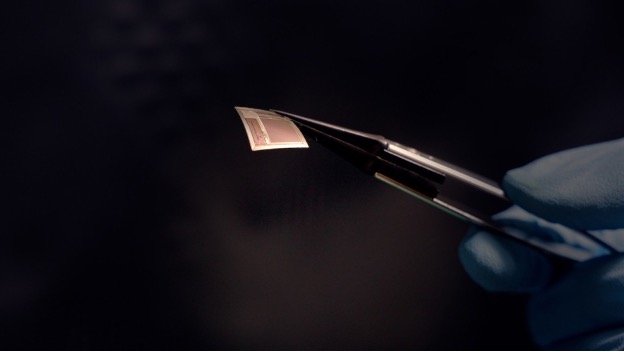
Researchers have created a completely transparent skin sensor that detects light and transforms it into electrical signals to quantify UV radiation precisely. Therefore, the user's smartphone will notify them when the Sun's rays are dangerously strong and it's time to cover up.
A group of researchers at Kyung Hee University in South Korea, under the direction of Professor Kang Sung-jun, have developed a see-through, highly effective sensor that can identify ultraviolet A (UVA) exposure. Although there are three types of ultraviolet (UV) radiation based on their wavelengths—UVA, UVB, and UVC—UVA is the most harmful since it penetrates deeply into our skin and avoids the ozone layer. Additionally, UVA radiation can cause wrinkles, early aging, and some types of skin cancer since they penetrate deeper into the skin, reports Bronwyn Thompson in New Atlas.
Although sun-detecting devices are not new, the researchers point out that only a small amount of transmitted UVA radiation penetrates through the sensor, making opaque wearables unable to estimate the quantity effectively. Additionally, it makes it challenging to integrate this technology with already-existing gadgets like smart glasses. The sensor's lightweight design allows it to be integrated into watches, bracelets, and apparel.
“If it is applied to smartwatches or fitness bands in the future, ultraviolet management will be possible even during everyday outdoor activities,” noted the researchers. “It will greatly help prevent skin cancer and support skin health management.”
Read more Hydrosense: Next-Generation Sweat Sensor
The researchers added see-through oxide semiconductors that only reacted to UVA light after starting assembly with a clear glass basis. Lastly, the tiny detector's electrical circuit was supplied via a transparent indium tin oxide sheet, making it simple to integrate with other wearables already on the market.
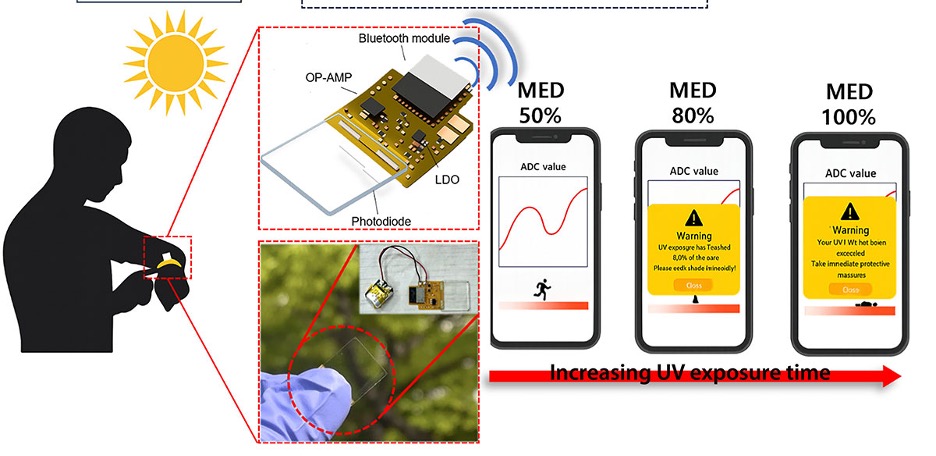
The team connected the device to a circuit board with an amplifier – to boost faint UVA signals – and a Bluetooth chip to send real-time data to a user's smartphone.
Both clear and overcast days were used to test the UVA-detector prototype in the sun, and the results matched those of professional UV monitoring equipment. The user's smartphone then received the UVA data, computed the cumulative exposure, and alerted the wearer when the levels hit 80% of what is needed to burn. This caution functions as a message that it's time to apply extra sunscreen or take cover.
The research was published in the journal Science Advances.