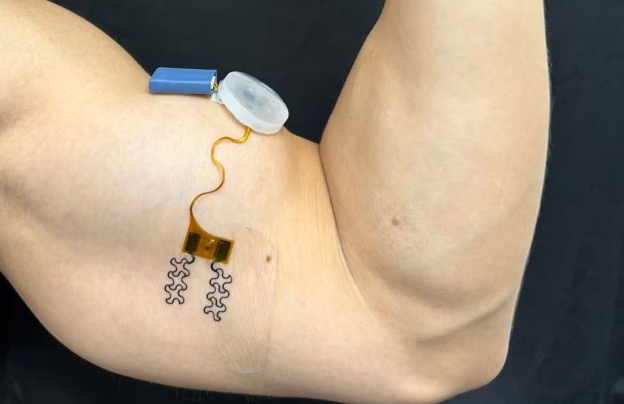
Researchers at The University of Texas at Austin have invented a new noninvasive, wearable sensor designed to measure a user’s hydration levels continuously. Such a device could help a football player stay hydrated on a hot September afternoon, keep a firefighter battling a blaze from getting too dried out, or just let an office worker know when it’s time to refill a water bottle, reports UT News.
“Dehydration is a silent threat that affects millions of people every day,” said Nanshu Lu, a professor in the Cockrell School of Engineering’s Department of Aerospace Engineering and Engineering Mechanics, who led the study published in the Proceedings of the National Academy of Sciences. “Our wearable sensor provides a simple, effective way to monitor hydration levels in real time, empowering individuals to take proactive steps to stay healthy and perform at their best.”
It uses bioimpedance, a technique that measures how electrical signals pass through the body, to track hydration levels. Using strategically placed electrodes, the sensor sends a small, safe electrical current through the arm.
How the electrical current flows through the body depends on the amount of water in the tissues. Water is a good conductor of electricity, so hydrated tissues allow the current to pass more easily, while dehydrated tissues resist the flow.
Data collected by the sensor is wirelessly transmitted to a smartphone, allowing users to monitor their hydration levels.
Read more Electronic Bandages Revolutionize Wound Treatment
Researchers conducted several experiments to test the device, including a diuretic-induced dehydration study and a 24-hour free-living trial. In the dehydration study, participants took a diuretic medication to promote fluid loss, and their hydration levels were monitored using the wearable sensor and then tested against a urine sample. The results showed a strong correlation between changes in arm bioimpedance and body weight loss due to water loss.
“Our experiments demonstrated that arm bioimpedance is not only sensitive to hydration changes but also aligns closely with whole-body hydration measurements,” said Matija Jankovic, co-author of the study and a postdoctoral researcher in Lu’s lab. “This means the sensor can be a reliable surrogate for tracking hydration levels, even during everyday activities like walking, working or exercising.”
Traditional methods for assessing hydration, such as urine tests and blood analysis, are often invasive, time-consuming and impractical for continuous monitoring. Commercial hydration assessment devices typically require bulky equipment and stationary setups, limiting their use in everyday life.
Lu and her team have used similar technology to create sensors to measure other aspects of human health, including:
A sensor to measure stress levels, which could help people working difficult jobs perform at their best.
A conductive ink that can be printed on someone’s head to measure their brainwaves.
Hydration is essential for human health. It plays a critical role in maintaining organ function, regulating body temperature, and supporting vital physiological processes.
In addition to protecting workers in extreme environments, the device has potential applications in health care. Continuous hydration monitoring could aid in diagnosing and managing conditions such as kidney disease, cardiovascular issues and chronic dehydration.
While the current version of the sensor tracks relative changes in hydration, future research aims to establish reference data for absolute hydration levels. This would involve collecting bioimpedance measurements from a large population to create a baseline for comparison.
The researchers also plan to explore new designs, such as breathable e-tattoos and sweat-wicking wearables, to improve comfort and performance during extended use. They hope to expand testing to larger groups and explore applications for other body segments, such as the forearm or thigh.
“This is just the beginning,” Lu said. “Our goal is to make simple hydration monitoring accessible to everyone.”