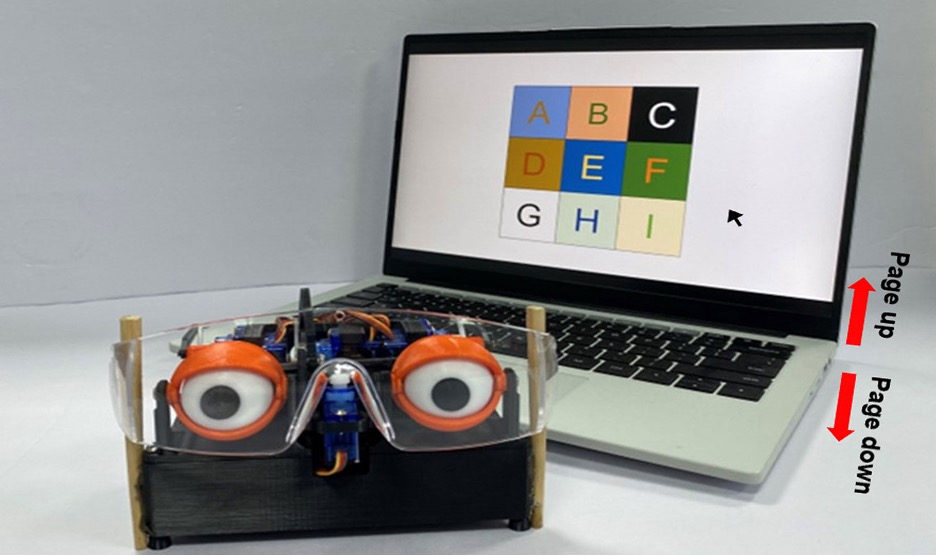
A team of Chinese researchers have created an amazing device that enables persons with restricted movement to use computers and view virtual reality content by only moving their eyes. The device can be powered by blinking.
According to the team, this has the potential to replace a lot of current-generation systems that can strain the eyes and rely on external power. Its solution is said to be as light as standard spectacles, making them more pleasant than the heavy substitutes of today. For those with amyotrophic lateral sclerosis (ALS), which severely impairs their ability to utilize their limbs and fine motor skills, it can be an attractive choice, reports New Atlas.
The wearable device detects even the smallest movements of the eyeball and precisely converts them into commands that make sense in the given context. A cursor may be moved across the screen by rotating your eyes to the left. Additionally, you may use your eyes to control the mobility of your wheelchair and navigate through text in a virtual reality setting.
The main wearing part of the system is a very thin, flexible coating of skin-safe, clear PDMS plastic that is applied to your eye like a contact lens. Its primary function is to produce a tiny amount of static electricity by rubbing on the eyelid during a blink. Additionally, there are special spectacles with lenses coated with transparent sensors known as substrate electrodes (made of a material called ITO). As the eye moves in various directions, they are positioned to "catch" the electrical signals produced by the contact lens.
Read more Rendever Launches VR Dementia Training
A tiny signal processing processor is attached to the glasses in order to filter out noise, boost the signal that the tracker receives, and convert it into commands like "turn left" or "move the cursor up".
The user's eyelid scrapes against the PDMS contact lens each time they blink. Due to this friction, a significant amount of negative static electricity builds up and is stored on the lens's surface. After a single blink, the lens remains charged for up to ten minutes. This stored static charge travels with the user's eye as they move it up, left, or right.
Electrostatic induction is the process by which the charged lens pushes and pulls electrons within the glasses' sensors as it approaches them. A brief electrical pulse is produced by this movement of electrons. Based on which sensor "feels" the electrical pulse, the system can determine precisely which direction the eye is gazing because the sensors are placed in a grid.
A live rabbit and a set of mechanical artificial eyeballs were used by the researchers to test the device.