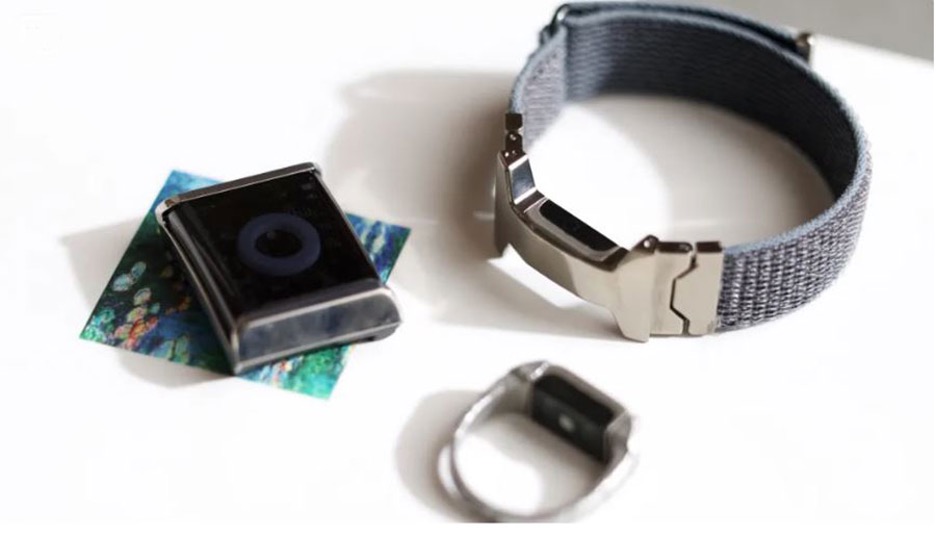
Choosing between a fitness band and a smart ring usually means giving up something. Alloop wants to remove that trade-off with a wearable that lets you switch the same tracking sensor between your wrist and finger.
One Sensor, Three Wearing Options
Called Alloop Trio, the modular health tracker was introduced by Dr. Tony Wu, RingConn’s co-founder and former CEO. The system includes a removable sensor called Cube, a wristband, a smart ring and an optional Halo module, reports GadgetsAndWearables.
The idea is to wear the ring while sleeping and switch to the wristband during the day, depending on what feels more comfortable.
Cube handles the actual health tracking. You can fit it into the wristband, use it with the Halo module or move it into the ring for a more discreet setup. The sensor weighs just 2.4 grams, has a 5 ATM water-resistance rating and offers up to seven days of battery life.
This design addresses a common problem with smart rings. Although rings can be comfortable for sleep tracking, they may get in the way during weight training, racket sports and certain types of manual work. Being able to move the same sensor between different wearables could make tracking easier without requiring two separate devices.
Cube uses optical sensors to measure resting heart rate, heart rate variability, blood oxygen levels, breathing rate and temperature. The Alloop app uses these measurements to generate sleep, recovery and strain scores.
Halo Adds Voice Notes and Battery Power
Halo gives the system some additional features. Attached to the wristband alongside Cube, it adds vibration alerts, colored light notifications, extra battery capacity and a button for interacting with Alloop’s AI Health Agent.
Read more Wearable Technology: Using Data to Improve Health
Users can press the button to record information that ordinary sensors cannot capture, such as meals, coffee consumption, headaches or how they felt after a workout.
These notes are saved in a feature called Easy Journal, where they can be reviewed alongside the data collected by Cube. Combining personal observations with sensor measurements could help users better understand how their daily habits relate to sleep, recovery and overall well-being.
Price and Availability
Alloop plans to launch its Kickstarter campaign on November 10, with a tentative price of $299. Early units are expected to reach backers around January 2027.
Takeaway
Wu’s experience at RingConn gives the project a founder with a background in wearable technology. Still, several questions remain, including how accurately the sensors perform, how well the software works, how durable the device is over time and whether the interchangeable components stay securely in place.
The main attraction is the modular design. Many screenless fitness trackers can monitor health and activity, but Alloop Trio aims to do something different by letting users move one sensor between a wristband and a ring.
That makes it an interesting concept, though not necessarily a purchase worth rushing into. As with any crowdfunding project, the finished product will need to prove that it can deliver on its promises. For now, Alloop Trio is a wearable worth watching as its launch approaches.