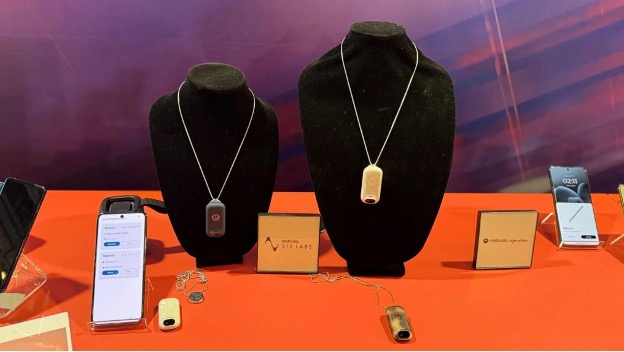
Motorola used CES 2026 to discreetly test the waters in the nascent AI companion hardware industry by showcasing a simple wearable that is intended to serve as a constant companion rather than a fully functional smart device. The product was introduced by Lenovo at its CES-related Lenovo World Tour events.
The device itself is compact and simple, more akin to a bulky pendant than a conventional device. It is suspended from a delicate necklace chain and has a shiny, pearl-like shell with gently rounded edges. A small camera lens and sensor array are placed at one end, while the Motorola emblem is subtly placed toward the center. There are no apparent buttons or displays, save from a small speaker slit and tiny pinhole microphones.
According to Mashable, Motorola stressed that the wearable is only an early proof-of-concept. The gadget, which is powered by Motorola's Qira AI assistant, is intended to function in concert with a paired smartphone rather than on its own.
During demos, the wearable summarized data, recognized and described items in the user's field of vision, and started navigation tasks by opening apps on a connected phone. In one instance, the device launched Google Maps and entered a route on its own, demonstrating a restricted type of agentic behavior as opposed to straightforward verbal responses.
Related Motorola’s New Bendable, Wearable Phone
Without committing to a release date, Motorola seems to be gauging industry and consumer response. The wearable is still a long way from being commercially available, the business stated, indicating that any further developments will probably depend on market preparedness and technological advancement.