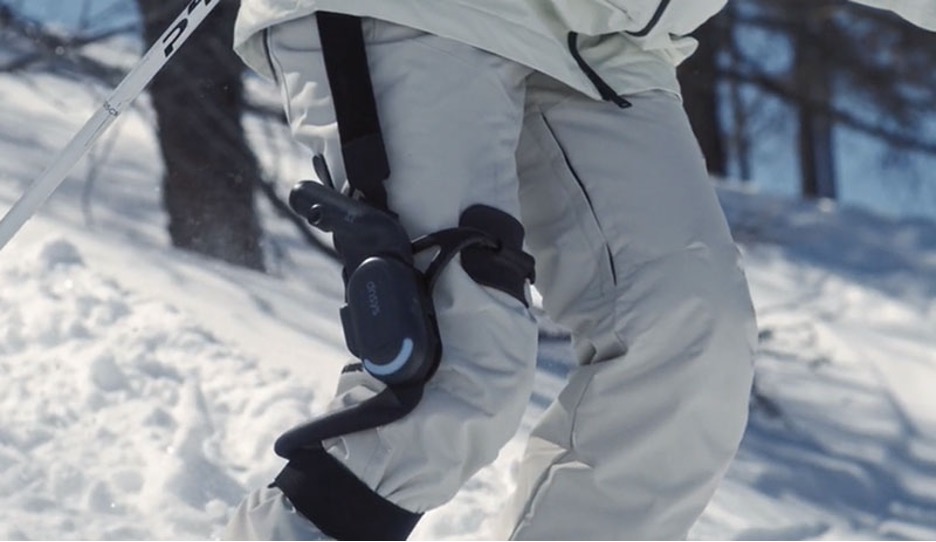
Hong Kong-based startup Dnsys has developed a knee exoskeleton that boosts leg strength by 50%. The Z1 knee exoskeleton also reduces knee pressure by 200%. The company was founded four years ago by robotics experts who previously worked for companies like Segway, DJI and Xiaomi.
Dnsys Z1 delivers continuous power to the wearer’s whole leg, helping them to climb higher, walk farther, and push past their limits, according to the Kickstarter campaign.
Dnsys’ independently developed knee motor delivers up to 900W of power. Its unique design transmits force simultaneously to the thigh and calf backs, generating lifting and pushing support for double output. This innovation provides strong assistance and significantly improves movement stability.
50% Boost to the Leg
Dnsys Z1 delivers up to 50% intelligent leg assistance, tackling slopes, challenges, and heavy loads, reducing burden by up to 77 lbs. It cuts muscle fatigue for farther walks, higher climbs, and effortless movement. Hikes: +15.5 miles. Climbs: +9.3 miles vertical.
Related KAIST Exoskeleton Walks and Puts Itself on to Disabled
200% Body Weight Pressure Reduction
We rely on our knees every day, yet often overlook how much stress they endure. While skiing, our knees can bear up to 700% of our body weight; hiking puts them under 500%, and even walking downstairs adds 300%. These repeated impacts silently wear down our knee health over time.
The Z1 uses AI-powered motors to evenly deliver force to the backs of the thighs and calves, providing intelligent cushioning that disperses and absorbs impact on the knees. It detects movement and load in real time, applying lifting force whenever the knees need support.
Two 1.5-lb (680-g) hinged exoskeletons that fit in a backpack and can be erected on each leg in a claimed 15 seconds make up the arrangement. Then, using padded supports, a 450-watt motor in each unit applies force to the thigh and the backs of the calf, pushing out against the calf and simultaneously raising the thigh forward.
When leg movements are detected by onboard torque, position, and force sensors, the motors are activated in as little as 0.01 seconds. As the user's movement patterns are learned by AI algorithms operating on a dual-core 240-MHz CPU (one per unit), the electrical aid can be applied more fluidly and organically.
Indeed, it has been reported that the AI can identify motions and change the help modes for tasks including walking, running, cycling, leaping, squatting, sitting, and standing.
Dnysys is offering the Z1 in three models. The mid-range aluminum/carbon fiber Dual Joint, which is described in this article, could be yours for a pledge of US$899 if it reaches production. The planned retail price is $1,499.