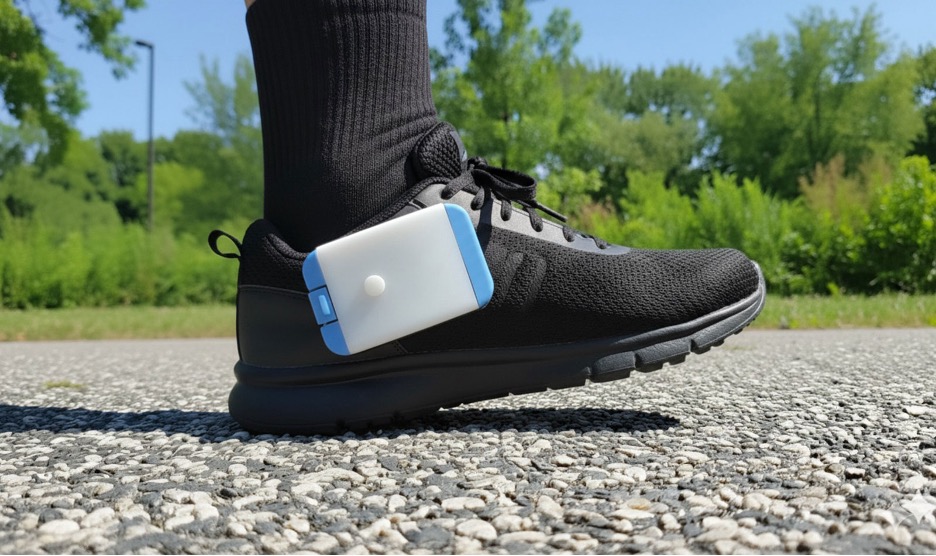
PhysioBiometrics Inc. has launched Heel2Toe, a wearable therapeutic device designed to assess and train older adults to walk with a proper gait, which is essential to reduce strain on joints and muscles, help prevent falls, and make walking easier to stay active and independent.
The Heel2Toe sensor attaches to the side of a shoe and beeps with each "good" step – one that begins with a strong heel strike. Heel2Toe has proven beneficial for older adults, including those with orthopedic or neurological conditions such as Parkinson's disease. It is believed to be the only wearable that provides real-time feedback for every step, Age-Well said in a press release.
"Many older adults do not walk well enough to gain health benefits from walking. Out of a fear of falling or low confidence in their walking, they often change their gait and take little shuffling steps that increase their fall risk," explained Dr. Nancy Mayo, President and CEO of Montreal-based PhysioBiometrics. "Heel2Toe is a game-changer for helping older adults age well because when your gait is better, you can walk farther. By intervening early enough to correct poor gait, older adults reduce fall risk, increase physical activity, improve joint and muscle health, and ultimately stay in their homes longer."
An optimal gait starts with a strong heel strike, followed by placing the foot flat, pushing off, swinging the leg, and repeating the process with little stride variability. With poor gait, people tend to shuffle – they don't put their heel down first, don't lift their foot, and the foot scuffs, increasing the risk of tripping. Gait tends to deteriorate in older adults due to neurological or orthopedic conditions, psychomotor slowing, and fear of falling.
Related Smart Insoles Accurately Measure Forces Created by Foot
"Essentially, Heel2Toe harnesses the power of the brain to change gait from the top down, so individuals re-learn to walk optimally," said Dr. Mayo, a Distinguished James McGill Professor in the Department of Medicine and the School of Physical and Occupational Therapy at McGill University. "Clients say that once they start using the sensor, they continue to 'hear' the beep even when not wearing it. They know which foot movement produces the sound."
Heel2Toe is a therapy tool that can be used independently at home with instructional videos, an exercise book and a web-based dashboard showing walking analytics, or under a therapist's supervision. Its three embedded inertial measurement units accurately assess walking patterns across the gait cycle. When a step begins with a strong heel strike, it provides positive, real-time auditory feedback, training an optimal gait. Focused practice – six minutes, twice a day – is recommended for best results.
Tamila Barab, an active 81-year-old retired Nurse Practitioner who now volunteers, recently had several falls, including one in her retirement residence hallway where she stepped toe-first and caught her foot on the flooring. She joined a PhysioBiometrics study in summer 2025 testing the independent use of Heel2Toe at home for one month. With the device, she learned to walk heel first.
"When I walk now, I'm conscious of going from heel to toe – I hear that voice in my head," said Ms. Barab, who continues to practice with Heel2Toe. "I find walking much easier this way, and I have more confidence in my walking."
A pilot study in individuals with Parkinson's found greater gait improvements with home training with the Heel2Toe device as compared to exercise recommendations alone. Walking capacity was the primary outcome: 13 of 14 participants in the Heel2Toe group improved on the six-minute walk test, while none of seven in the exercise-only group did.
PhysioBiometrics is also using the Heel2Toe as part of its Walk-BEST Program – an in-person group training program combined with at-home practice. The program is currently offered to older adults in the Montreal area.
About AGE-WELL
AGE-WELL is Canada's Technology and Aging Network. As a dynamic pan-Canadian network with global reach, AGE-WELL has mobilized a vast community of researchers, older adults, caregivers, partner organizations and future leaders to accelerate the delivery of technology-based solutions that make a meaningful difference in the lives of older Canadians and their caregivers. AGE-WELL's groundbreaking programs are funded by the Government of Canada through Innovation, Science and Economic Development Canada, Health Canada, and the Canadian Institutes of Health Research.