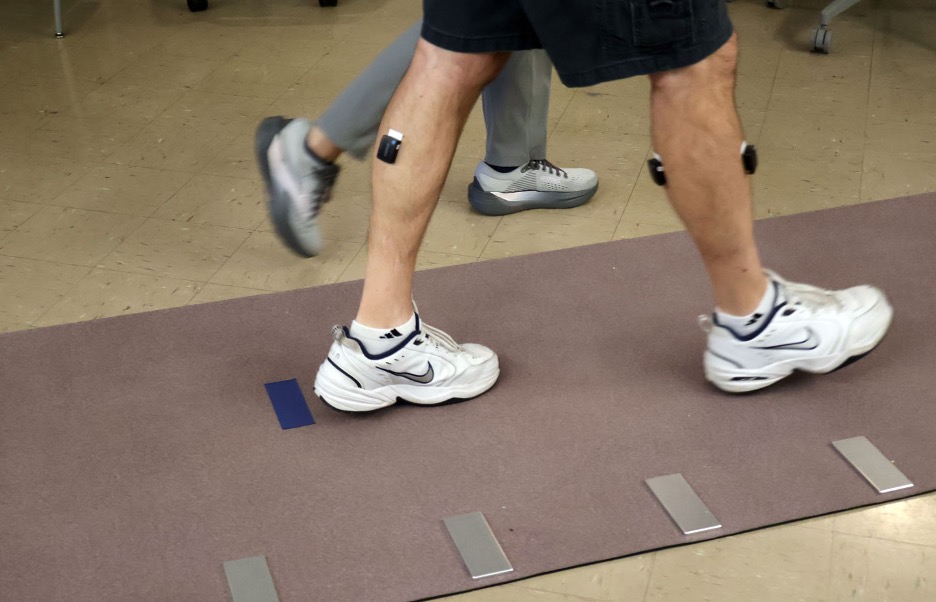
Virtual reality and wearable sensors could help researchers better understand how Parkinson’s disease affects walking and how rehabilitation can be tailored to each patient.
That’s the goal of a research project led by Rui Hua, an assistant professor of biostatistics and health data science at Lehigh University’s College of Health. Hua, who has a background in electrical engineering, leads the Smart Wearable Electronics and hEalth daTa (SWEET) Research Group. His team develops wearable and AI-based technologies for neurological rehabilitation and remote monitoring of people with Parkinson’s disease, reports Lehigh University.
The researchers are building a virtual reality platform that uses wearable sensors to measure walking problems, including a symptom known as freezing of gait. This occurs when a person suddenly becomes unable to move their feet, as if they were stuck to the floor. These episodes can increase the risk of falls and make everyday activities more difficult, reducing a person’s mobility and independence.
Why Virtual Reality Matters
Assessing someone’s walking ability in a clinic does not always reveal how they move in everyday life. Real-world situations, such as passing through a doorway or navigating a narrow hallway, can present different challenges.
Hua’s team wants to recreate these situations in a controlled virtual environment. Participants will navigate obstacles while wearable sensors record their movements. Researchers will then analyze the data with clinical experts to identify meaningful patterns in their walking.
The goal is to give clinicians a clearer picture of each patient’s movement difficulties and help them design rehabilitation programs that better match individual needs.
The project brings together researchers and healthcare professionals from several institutions. Carly Haffner, an occupational therapist at Good Shepherd Rehabilitation, contributes clinical expertise. Mooi Choo Chuah, a computer science and engineering professor at Lehigh, co-leads the virtual reality development. Jenny Bartoff, an assistant professor at Oregon State University-Cascades, also serves as a clinical collaborator.
Finding the Right Cues for Each Patient
The team is also investigating whether sound and touch can help people with Parkinson’s walk more steadily.
Related Canadian Startup Launches Wearable to Improve Gait
Auditory cues might include a metronome or music with a steady rhythm. Tactile cues could come from vibrations delivered by a wearable device. Both approaches are intended to help patients coordinate their steps.
However, researchers have not established that one type of cue works better than the other in all cases.
Hua believes the most effective approach may differ from person to person. One patient might respond well to music, while another might benefit more from vibrations from a wearable device. Identifying which cues work best for each individual could make rehabilitation more effective.
Students Help Develop the Technology
Students from across Lehigh University are also contributing to the research.
Graduate student Thoi Quach, from the P.C. Rossin College of Engineering and Applied Science, serves as the technical lead for the virtual reality project. Undergraduate students contribute to research coordination, music customization and clinical feedback.
Noelle Barone, a psychology major with a minor in health policy and politics, coordinates research activities as the research engagement ambassador. Lillian Linnell, who studies population health and biology, leads the work on customizing music as a rhythmic cue to help patients coordinate their steps.
Sophie Weiskopf, a community and global health major, and Alex Lien, a biology major with a minor in health, medicine and society, are interviewing clinicians. Their work helps ensure that the technology reflects the needs and experiences of healthcare professionals.
Working With the Parkinson’s Community
The research team is recruiting participants through Good Shepherd Rehabilitation Network’s weekly Parkinson’s boxing program and local Parkinson’s support groups.
By combining wearable technology, virtual reality and clinical expertise, the researchers hope to make gait assessments more useful and rehabilitation more personal. Their work could help clinicians better understand the challenges people face when walking and identify strategies that support safer movement and greater independence.
The broader aim is to develop practical technologies that improve rehabilitation and make care more responsive to the needs of people living with Parkinson’s disease.