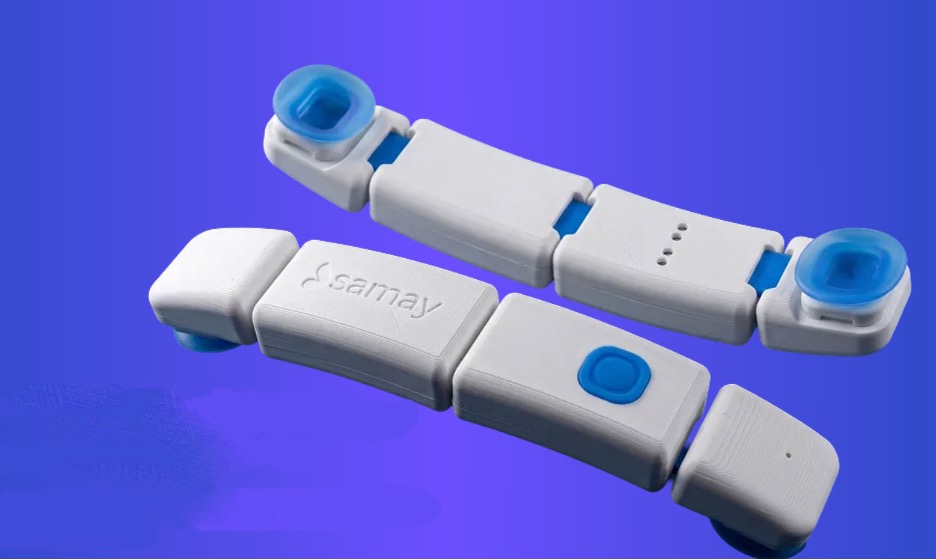
The Colombian-founded medtech startup Samay has expanded its funding expectations, officially closing a $7 million seed round. While the company initially aimed for a $3 million target earlier this year to launch its platform, strong investor demand pushed the total capital raised to $7 million to accelerate its AI-driven respiratory health technology. Samay is founded by Colombian physician María Artunduaga.
This shift is largely due to staff reductions at the U.S. Food and Drug Administration (FDA) during the Donald Trump administration; according to Artunduaga, these cuts resulted in the loss of nearly half the agency's workforce and drove up the cost of entry for medical device and biotechnology companies. This environment, the founder notes, has prompted many U.S. companies in the sector to launch outside the country first and return later, reports Forbes.
Artunduaga held talks last week with Invima to fast-track health registration in Colombia and plans to leverage the agency's agreements within the Andean region to extend approval to Peru, Chile, and Ecuador. The company is also exploring entry into Brazil and Mexico, where it is in discussions with investment funds and healthcare systems.
The firm has raised nearly US$7 million since its inception, with 40% to 50% of that total coming from non-dilutive capital via U.S. government grants. After operating primarily as a research project for its first five years, Samay has now secured 18 patents across more than 20 countries.
At the same time, the company began generating revenue through strategic partnerships. It completed a pilot program with a European pharmaceutical company—surpassing technical milestones by over 20%—and is currently negotiating a contract valued in the six-to-seven-figure range. It is also conducting a U.S. government-funded pilot with ResMed (a manufacturer of sleep apnea devices) and collaborating with a Chicago hospital to detect respiratory failure in epilepsy patients. This commercial momentum is driven by a business model the company discovered over the past year: pharmaceutical and device companies pay it to develop artificial intelligence models based on clinical trial data, which they then purchase or license for use in the specific disease areas where they are developing treatments.
Related Chest Drainage System Granted FDA Clearance
On the capital front, Samay received nearly US$200,000 from Epic Angels, a Cali-based syndicate of female angel investors led by Vivian Argueta. The deal, which involved 69 women, marks the syndicate's largest investment in Latin America and the second-largest in its history.
The device, named Sylvee in honor of the founder’s grandmother, costs US$70 and functions like a pair of headphones for the chest: it emits sound to make the lung resonate—"we make the lung sing," explains Artunduaga—and captures 750 acoustic characteristics used to build algorithmic models.
According to the company, these models achieve an area under the curve of 93% compared to a CT scan—equipment costing US$1.5 million—with its various algorithms ranging between 82% and 93%. Samay maintains that it can detect COPD up to five years earlier than the US$80,000 machine currently used as the diagnostic standard.
The company has tested the device on approximately 500 people and aims to reach 3,000 over the next year and a half. It is also preparing a partnership (not yet disclosed) to establish Colombia as a center of excellence for respiratory clinical trials, featuring a cohort of over 2,500 patients with conditions such as COPD, asthma, cystic fibrosis, tuberculosis, and lung cancer.
Samay—which in 2024 became the first Latin American company accepted into the MedTech Innovator accelerator—won the StartCo awards in Medellín this year (topping a ranking of 350 companies) and GoFest in Bogotá last year; these accolades opened doors with the Bogotá Chamber of Commerce and Invest Bogotá, while the Dubai Chamber of Commerce is exploring the possibility of bringing the company to Dubai in December for pilot programs.
The founder plans to manufacture the device entirely in Colombia—starting with an initial batch of 1,000 to 2,000 units—in compliance with Invima’s Good Manufacturing Practice guidelines. The company currently employs 22 people, more than half of whom are women, including two based near Buenos Aires.