Drawing blood, sending samples to a laboratory, and awaiting findings: Time-consuming tests are frequently used to monitor metabolic health. Two University of Duisburg-Essen master's students wish to change that. They are creating a wearable sensor device called VitaMetis with the goal of continually monitoring a number of metabolic markers without the need for invasive procedures. Abdulmohaimen Algamoudi and Abdullah Osman Gwela have qualified for the national COSIMA competition thanks to their proposal.
What if checking levels of urea, vitamins, and even hormones were as simple as tracking your heart rate with a smartwatch? That is the idea behind VitaMetis, a project led by Abdulmohaimen Algamoudi, 27, and Abdullah Osman Gwela, 28, two electrical engineering master's students at the University of Duisburg-Essen (UDE). After more than a year of development, they are preparing to present a working prototype in Munich, reports NewsMedical.
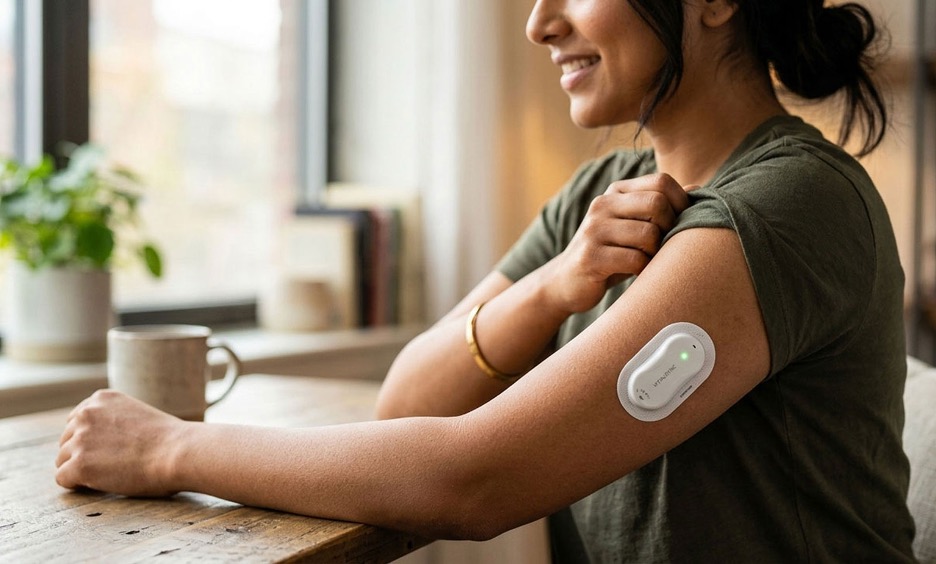
The project is built around a small wearable patch that continuously monitors metabolic indicators through sweat. Using optical sensing technology, it identifies specific substances and measures their concentrations. The system relies on carbon nanotubes (CNTs), a technology developed for practical use at the Fraunhofer Institute for Microelectronic Circuits and Systems IMS in Duisburg.
A handheld scanner reads the patch's measurements, eliminating the need for blood samples or any procedure that penetrates the skin.
VitaMetis is still in development, and the students acknowledge that commercial availability is some way off. Their goal, however, is to make the technology useful to a wide range of people, from healthy individuals and athletes to pregnant women and patients with kidney disease.
Related AI Wearable Patch Detects Heart Rhythm with 99.6% Accuracy
"We want to develop a technology that benefits as many people as possible," says Algamoudi.
For Gwela, the potential impact is particularly personal. Coming from Libya, where access to healthcare can be limited, he believes wearable monitoring technology could make a meaningful difference in people's lives.
The project has already attracted sponsors, along with support from UDE and their supervisor, Prof. Dr. Karsten Seidl, of the Electronic Devices and Circuits research group. The team is now preparing to showcase its prototype in Munich as it works toward turning the idea into a practical health-monitoring solution.
"We're going to Munich," Algamoudi declares, "to win COSIMA!"