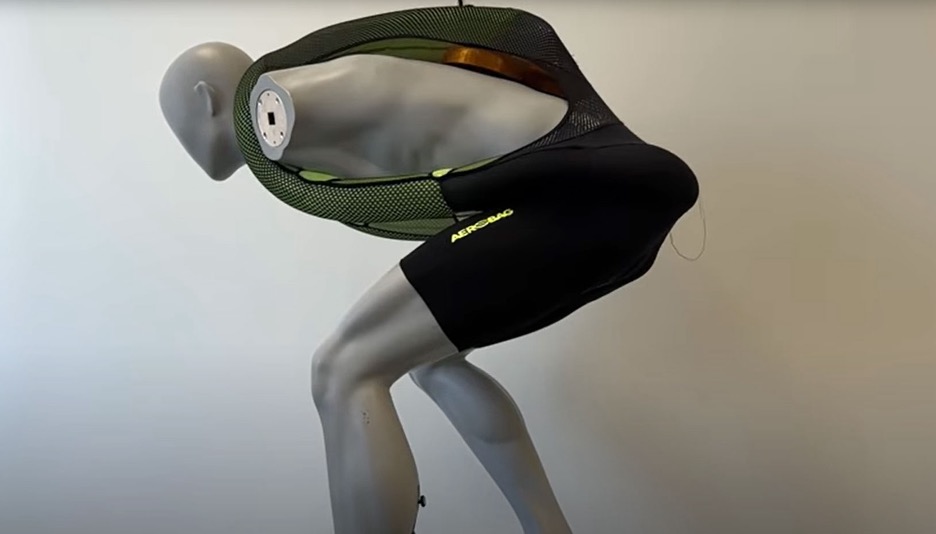
A safety solution designed specifically for cyclists, the Aerobag system maximizes riders' peace of mind when they go out for training or recreational riding. The system consists of an aerodynamic pouch on the wearer's back that contains the necessary electrical components and a replacement CO2 cartridge. Nine motion sensors are used by the system to continuously scan the wearer and activate the airbag system if a crash is detected.
The system is made by a Belgian firm of the same name. It's designed for use by professional cycling teams, and will in fact be used by the Netherlands' WorldTour Team Picnic PostNL for training this season, and possibly for races. Other pro tour teams are reportedly in the works, reports New Atlas.
Aerobag uses electronic sensors and software to detect a crash and trigger inflation.
“It’s all fired by an algorithm,” explains Quinton van Loggerenberg, Aerobag international business development manager. “There are XYZ sensors, inertia sensors, impact sensors, and there are magnetic fields to give you a fixed zero – the system is very clever”
Related Shimano Receives US Patent for Cycling Shoes
He explains that cycling kit needs to be lightly modified to accommodate the system: “That’s only because we need to control where the tubes go so that the inflation happens in the right place”
The Aerobag uses its cartridge to inflate a network of sleeved TPU (thermoplastic polyurethane) tubes that are channeled through the slightly altered straps of the cyclist's third-party bib shorts. These tubes expand to create airbags that shield the neck, spine, chest, and hips from severe collisions in as little as 100 milliseconds.
Importantly, the cyclist can continue racing after the collision by folding the now-deflated tubes back into the shorts. The Aerobag system is completely reusable except for the need to refill the CO2 cartridge.
Pricing should eventually be between €700 and €850 (about US$815 to $990), according to van Loggerenberg.