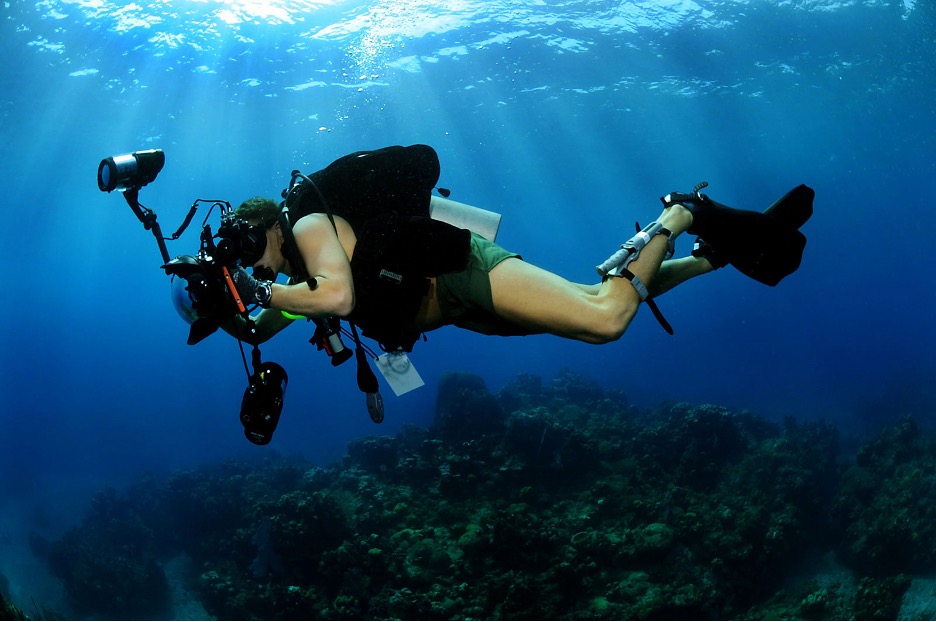
An exoskeleton created by academics at Peking University may eventually give divers a much-needed boost to their flutter kicks. The gadget may help extend the life of scuba tanks by relieving some of the strain of underwater swimming.
Although the action appears to be rather serene and soothing when one watches a diver glide through the water beneath the sea's surface, the technique truly works the legs, which are the largest muscle groups in the body. A diver's tank supplies the oxygen needed for all that muscle contraction. The typical lifespan of oxygen for a diver using an 80-cubic-foot tank at a depth of 65.6 feet is between 35 and 50 minutes, reports New Atlas.
Rather than concentrating on breathing apparatus, the PU researchers adopted a novel strategy to increase the amount of time a swimmer could stay beneath on a single scuba tank: reducing the energy used during swimming and, consequently, the oxygen required by the diver.
Their exoskeleton is made up of several components. The diver's back is equipped with two sealed motor units. These are attached to pliable Bowden cables that descend to lightweight handcuffs on the diver's shanks and thighs. The complete device, which mounts outside a diver's wetsuit, is stabilized by a waist strap. The diver's back bears the majority of the system's weight, which is around 9 kg (20 lb).
Related Exoskeleton with Motor Has More Power
The sensors included into the system known as Inertial Measurement Units (IMUs), which relay the location of the legs to the motor, are the source of the exoskeleton's true magic. This enables the motor to detect the location of the diver's legs during the flutter kick and modify the force applied to the Bowden cables as necessary. The motor engages and helps with the motion during the kick's downstroke because of an integrated clutch. To prevent the device from interfering with the diver's recovery motion during the upstroke, the motor is disabled.
Six qualified divers were given an exoskeleton by the researchers to test the system in a 50-meter (164-foot) swimming pool at a depth of two meters (6.6 feet). Each diver used a flutter kick to accomplish three 100-meter (328-foot) underwater swims, both with and without the exoskeleton and with and without its power. The test showed remarkable results, with a 22.7% decrease in air intake and a slightly over 20% reduction in quadriceps and calf activity.
The researchers say more testing is needed to further refine the exoskeleton.
"Our work provides a reference for the design and assessment of future underwater assistive devices, with the potential to strengthen the connection between humans and the ocean and to broaden the horizons of exploration,” the researchers said.