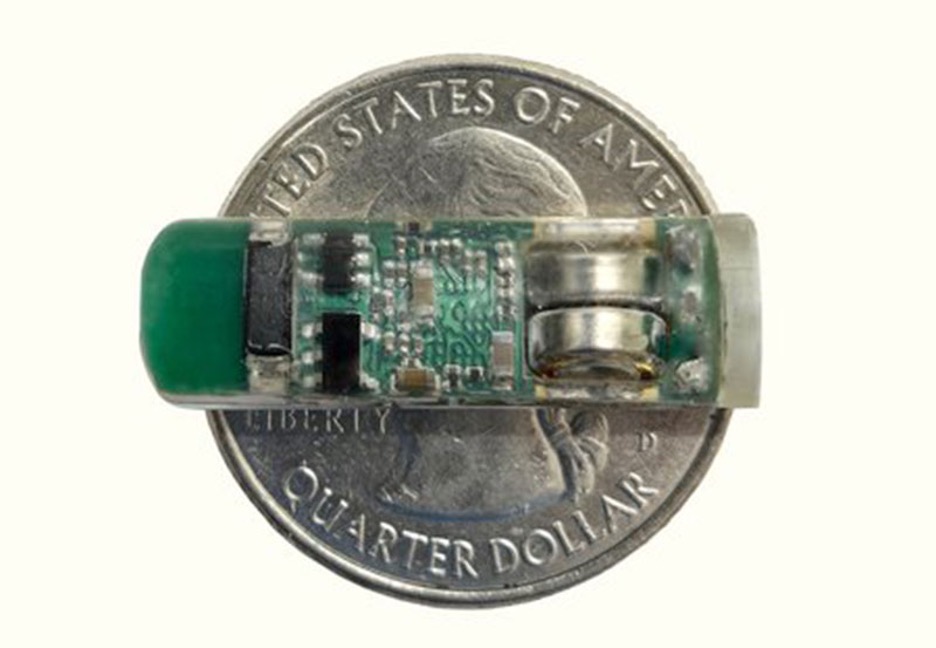
A team of Caltech engineers has developed a smart capsule called PillTrek, which can measure pH, temperature, and a variety of different biomarkers. It incorporates simple, inexpensive sensors in a miniature wireless electrochemical workstation that relies on low-power electronics. PillTrek is tiny, measuring 7 millimeters in diameter and 25 millimeters in length, making it smaller than commercially available capsule cameras used for endoscopy but capable of executing a range of electrochemical measurements.
"We designed this pill to be a very versatile platform," says Wei Gao, professor of medical engineering at Caltech and a Heritage Medical Research Institute Investigator. "From an electrochemical-sensing point of view, it is very powerful. It has the ability to measure metabolites, ions, hormones such as serotonin and dopamine, possibly even proteins as well. And all within the gut, which is a complex environment."
The scientists describe the capsule in a new paper in the journal Nature Electronics. The lead authors of the paper are Jihong Min, a postdoctoral scholar fellowship trainee in medical engineering at Caltech, and Hyunah Ahn, a visitor in medical engineering at Caltech and graduate student at the Korea Advanced Institute of Science and Technology (KAIST), reports Caltech.
As a proof of concept, PillTrek was used in the study to measure pH and temperature as well as changing levels of glucose and the neurotransmitter serotonin in animal models.
Gao points out that the electrochemical workstation within the capsule is reconfigurable. A variety of different sensors could easily be swapped into place to enable measurements of different parameters in the gut. His team previously developed a technique for 3D printing inexpensive sensors on sheets of plastic substrate. That technique can be used to mass-produce the sensors for PillTrek.
Related Robeauté’s Brain Microrobot
In terms of next steps, Gao says that he is working with co-author Azita Emami, the Andrew and Peggy Cherng Professor of Electrical Engineering and Medical Engineering at Caltech, to look into wireless power transfer and smaller electronics that would make PillTrek even smaller and lower power.
"Ingestible capsules have significant potential in diagnosis, monitoring, and management of chronic conditions, but previous devices were very limited in terms of their sensing capabilities, lifetime, and size," says Emami, who is also director of the Center for Sensing to Intelligence. "This work is an important translational step toward devices that can provide meaningful medical information for patients and physicians."