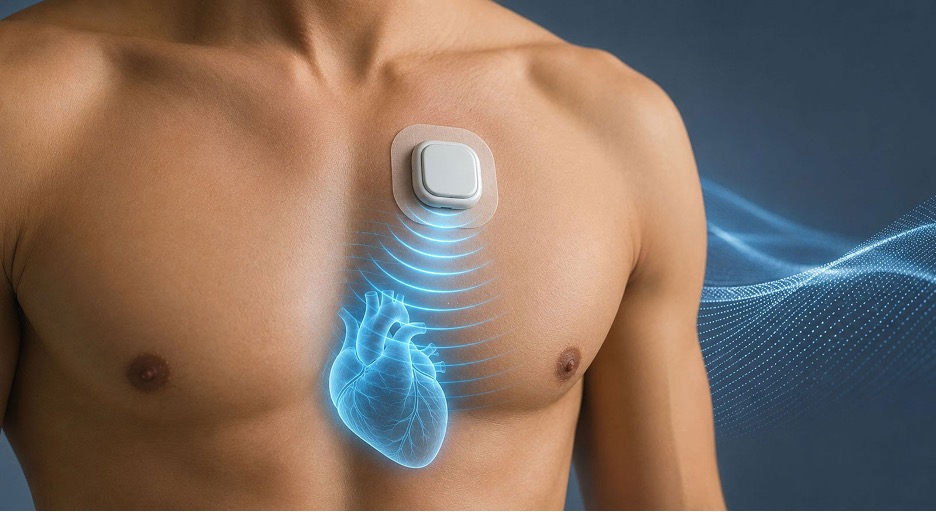
A new, innovative patch developed by researchers at the Norwegian University of Science and Technology (NTNU) could make heart health monitoring more accessible. When used with a regular smartphone camera, the transparent patch can measure both heart rate and blood vessel stiffness without requiring any electronic components.
At first glance, the patch looks like a small, transparent sticker with rainbow-like reflections across its surface. The effect may remind some people of the colorful underside of an old compact disc, reports NewsMedical.
Despite its simple appearance, the technology offers a way to collect valuable information about the heart and cardiovascular system using nothing more than the patch and a smartphone. Made from silicone rubber, the device requires no batteries, wires, or electronic sensors.
Inspired by an Octopus's Suction Cups
The patch has two distinct surfaces. One features a nanoscale pattern that changes color when the material stretches. The other contains a specially designed three-dimensional adhesive structure inspired by the suction cups of an octopus, helping it stay firmly attached to the skin.
"We wanted to develop a flexible, low-cost device. What makes it unique is that we can clearly see the signal from the heart on the patch with our own eyes," says Angelos Xomalis, associate professor of electronic systems at NTNU.
As blood moves through the vessels, the resulting pulse waves cause tiny movements in the skin. These movements stretch the patch slightly, producing subtle but measurable changes in the color of its nanostructured surface.
Related Wearable Patch Aims To Detect Falls and Notify Families
A camera can capture these changes and use them to extract information about the heart. Unlike many existing measurement technologies, the patch does not require a spectrometer, laser, or specialized optical equipment. Even an ordinary smartphone camera is sufficient.
A Different Approach to Smartwatch Technology
Although the patch may seem similar to a smartwatch that tracks heart rate, the underlying technology is quite different.
Most smartwatches use green LED lights on their underside to monitor changes in blood volume beneath the skin. This technique, known as optical monitoring, measures how light interacts with blood vessels over time. However, optical sensors have a significant limitation: their accuracy can vary depending on skin pigmentation.
"One drawback of smartwatch measurements is that they are strongly influenced by the amount of pigment in the skin," says Xomalis.
This means that optical monitoring may be less reliable for people with darker skin tones, raising concerns about equal access to accurate health monitoring.
"Optical measurements are not equally accurate for all skin types. Naturally, this is a significant issue when it comes to equitable healthcare services," Xomalis explains.
The new patch takes a different approach. Rather than measuring how light is absorbed by the skin, it detects the physical movements of the skin's surface. This allows the device to measure not only heart rate but also the stiffness of blood vessels, providing additional information about cardiovascular health.
Measuring Blood Vessel Stiffness
Blood vessel stiffness is an important indicator of cardiovascular health. As people age, their blood vessels generally become less flexible. However, lifestyle factors can influence this process.
"We know that blood vessels generally become stiffer with age. However, if you exercise a lot and have a really healthy lifestyle, you can maintain a relatively youthful vascular system. However, if you're a heavy smoker, your blood vessels may appear biologically older," says Torjus Lines Steffensen, a postdoctoral fellow in medical imaging at NTNU.
Stiffer blood vessels are associated with an increased risk of several cardiovascular conditions. Measuring this characteristic can therefore provide valuable information about a person's overall heart health.
Traditional smartwatch sensors are not designed to measure blood vessel stiffness directly, making this a particularly useful feature of the new patch.
"In short, we can extract more information using the patch," says Steffensen.
Could Replace Expensive Medical Equipment
Currently, measuring blood vessel stiffness often requires sophisticated medical equipment. Electrodes are attached to the patient's chest, arms, and legs and connected to an electrocardiogram (ECG) machine through wires.
Patients may also be familiar with the small, illuminated clip placed on a fingertip to measure pulse rate and blood oxygen saturation. Such equipment is commonly available in hospitals, emergency departments, ambulances, and primary healthcare clinics. However, access to these resources can be limited in remote or underserved regions.
"In Norway, this works fine. However, the challenge arises if you are in a remote location in Africa, or other parts of the world where specialized medical personnel and advanced equipment may be far away," says Xomalis.
The new patch could help address this challenge by simplifying the process of collecting cardiovascular measurements. Healthcare workers would essentially need only a smartphone to use the technology, making it potentially useful in locations where access to advanced medical equipment is limited.
"What we are essentially doing is taking a lot of the complexity involved in these measurement systems and shifting it to the smartphone," says Steffensen.
A New Generation of Affordable Health Sensors
Because it is inexpensive, requires no external power source, and works with widely available smartphones, the technology could make certain cardiovascular measurements more accessible to people around the world.
The innovation was developed entirely at NTNU, where researchers designed, manufactured, and tested the patch.
If further development and validation demonstrate its effectiveness in real-world healthcare settings, the technology could offer a simpler way to monitor heart health, particularly in communities where conventional medical equipment and specialist services are difficult to access.