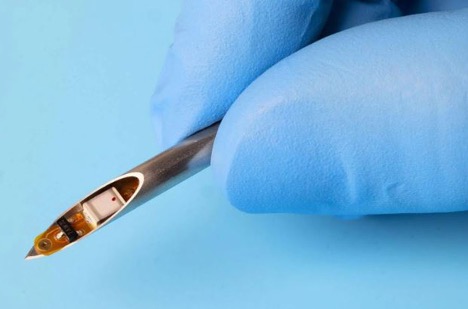
Georgia Tech engineers have developed a wireless networking system that enables wearable technology and tiny implantable sensors and actuators to connect with one another by using the human body to convey data.
Because of their system, devices can cooperate like never before, sensing in one area of the body and causing a therapeutic reaction in another, possibly by activating a nerve or releasing medication.
Described Sept. 24 in the journal Science, their communication method is expandable to include multiple interconnected devices across the body, even deep inside the stomach, reports Joshua Stewart in Georgia Tech.
“With our system, you can now place sensors in the best possible place to detect a biological signal and place actuators in the best possible place to perform a therapeutic action,” said Alex Abramson, the study’s senior author and an assistant professor in the School of Chemical and Biomolecular Engineering. “They don't need to be connected, aligned, or even near each other; they can just send signals to each other through the surrounding tissue.”
The researchers aimed to imitate the same level of connectedness the body achieves through the nervous system. They call their invention SWANS for Smart Wireless Autonomous Networking System.
Related How Wearables are Unlocking the Secrets of the Human Body
According to Abramson, the degree to which wearable technology and implants can cooperate has historically been constrained by our bodies' poor ability to transmit conventional wireless signals like Bluetooth or NFC. Large antennae and a lot of power are also needed for those communication, therefore implants need to be big enough to fit those parts.
By utilizing the inherent ionic conductivity of bodily tissue as the link between devices, SWANS eliminates these restrictions.
To enable selective activation, each implant is designed to react to electrical pulses of a particular voltage and duration that are transmitted from one device to another through the tissue. Additionally, they can be configured to synchronize data from various sensors both within and outside the body in order to initiate a possible therapeutic action.
“I’ve always been passionate about creating devices that improve patient quality of life,” said Ramy Ghanim, a Ph.D. student and first author of the Science study. “Automation improves outcomes and simplifies treatment regimens for patients.”
In their study, the researchers demonstrated dual-limb motor control in a rat by coordinating a full-body network of sensors and neural interfaces. Their sensors detected when the rat’s front paw moved and autonomously triggered another device to stimulate and contract the muscle in the hind leg, simulating the animal’s natural walking pattern.
SWANS is designed to transmit only small amounts of data between and among devices — the presence or absence of something or a yes/no trigger for some action. Larger data exchanges or heavy computation happens on an external wearable hub that can coordinate sensor readings from implants and direct therapeutic actions by others.