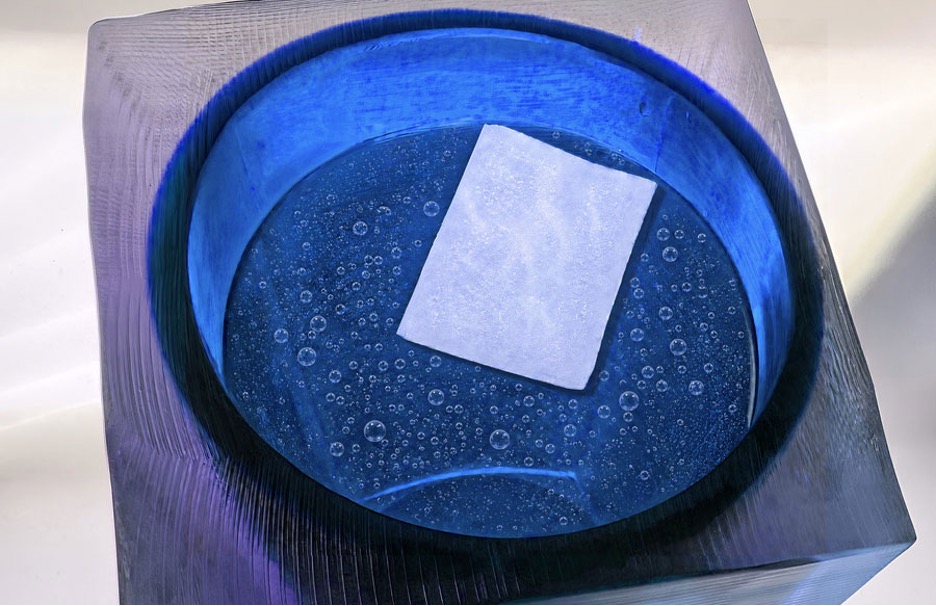
Hydrogels are biocompatible, pliable materials composed primarily of water and a small amount of polymer. The Jell-O-like material can be applied to the skin or implanted in the body to treat wounds, attach implants, and encapsulate and release medication gradually. It is accessible as medical patches, sprays, and glues.
Despite all of their protective, elastic, and sticky qualities, hydrogels lack one essential characteristic: breathability. Wearing a bandage or patch for an extended period of time can trap perspiration and moisture, irritating tissues and decreasing the efficacy of any device that a hydrogel clings to.
Now MIT engineers have come up with a recipe for a hydrogel that is both hydrated and aerated, or permeable to air. The new material is just as soft, stretchy, and robust as conventional hydrogels, but a network of tiny tunnels running through the gel allows air to pass through, reports Jennifer Chu in MIT News.
Compared to traditional hydrogels, the aerated hydrogel can be worn for extended periods of time without irritating the skin. Even when exercising, it can lessen perspiration accumulation. The new breathable hydrogel was used to affix wireless cardiac monitors to the chests of experiment participants. The volunteers did not exhibit any signs of skin irritation after engaging in regular exercise for ten days, and the heart monitors continued to read well.
The results, which are reported in the journal Nature, may enable longer-lasting hydrogel products, such as breathable bandages and dressings, cosmetic face masks, and contact lenses, along with better-performing health monitors and implants.
“Water and oxygen are both essential for life,” says Xuanhe Zhao, the Uncas (1923) and Helen Whitaker Professor of Mechanical Engineering, and a professor of civil and environmental engineering, and medical engineering and science. “Now that we’ve added air to hydrogels, people can find broad applications.”
Breathing through Jello
Water makes up about 90 percent of a typical hydrogel. The rest of the material consists of polymers. When mixed with water in a chemical process known as “cross-linking,” the polymers settle into a sort of scaffold that holds the water in place, forming a gel that’s both squishy and stretchy. But because hydrogel’s composition is mainly water, it’s inherently challenging for any air to make its way through the material effectively.
Read more AI Wearable Patch Detects Heart Rhythm with 99.6% Accuracy
“In general, water is not breathable,” co-lead author Xiao-Yun Yan says. “Hydrogel is 80 to 90 percent water, similar to Jell-O. And you cannot breathe through Jell-O.”
Other groups have tried to design air-permeable hydrogels, mainly taking one of two approaches. The first has been to essentially puncture microscopic holes throughout the gel. Such designs are breathable, but only in air. When they are placed in liquid, the holes quickly clog up.
Zhao and his colleagues took advantage of viscoelastic phase separation in concocting a breathable hydrogel. For their new design, they mixed their conventional hydrogel recipe with a very small amount of silica aerogel particles, which are essentially “solid-form” air bubbles.
“They are like boba beads,” Yan offers. “The particles are made of silica, which is hydrophobic, meaning that water does not want to leak through them, so they are very stable in water.”
And as it turns out, the particles are similar to oil when mixed with water. The researchers found that when they mixed just a small amount of the particles with a solution of the water-heavy hydrogel, the water molecules glommed together, essentially finding each other faster than the less abundant silica particles.
Zhao says the new study provides a novel approach for others to fabricate breathable and multifunctional hydrogels, using the concept of visoelastic phase separation as a guide.
“We’ve discovered that this process can create these air-permeable hydrogels, and we demonstrate one application,” he says. “But we think there can be very broad applications. This is a technology platform.”