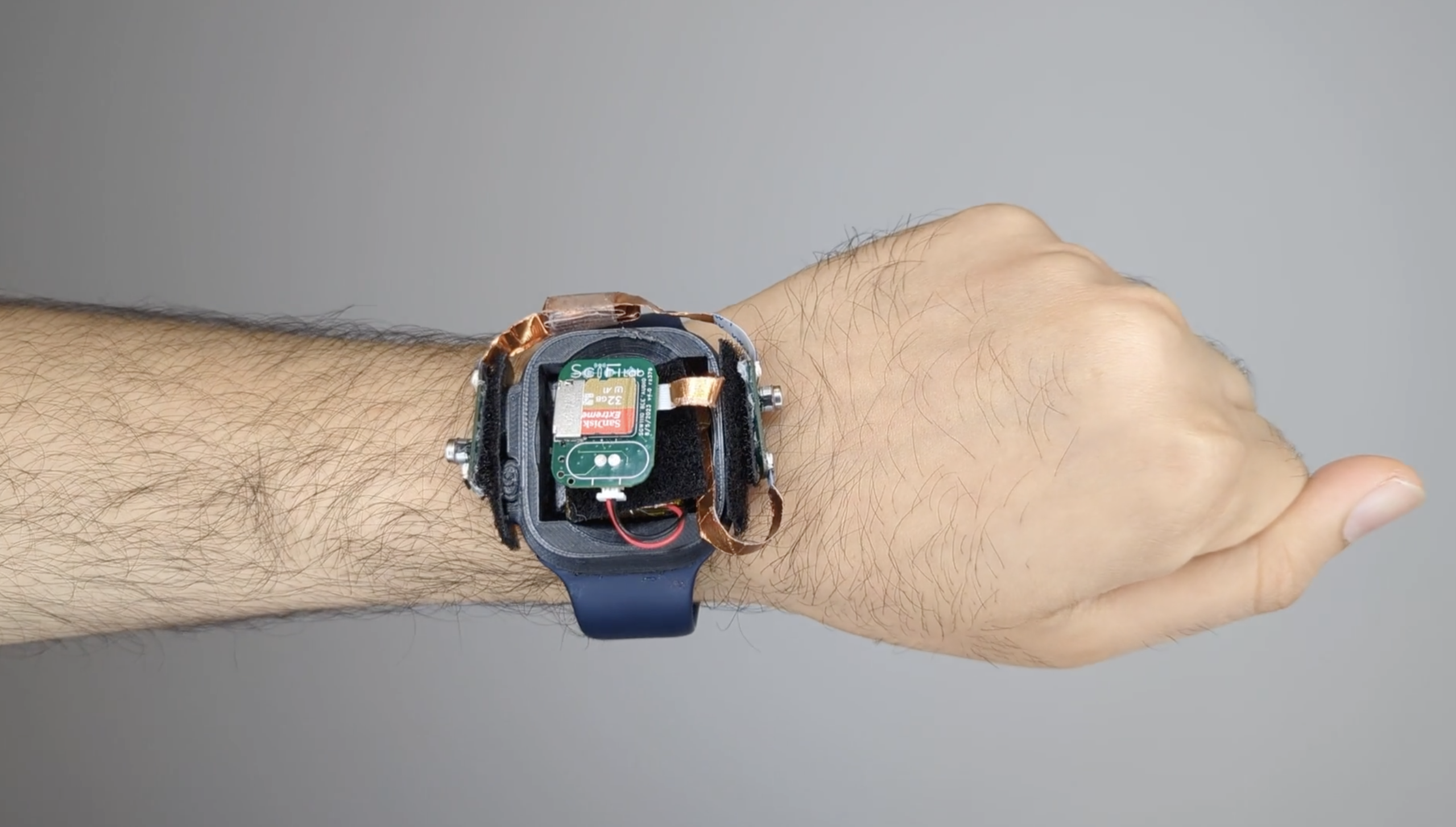
Smartwatches can count steps, but they usually have no idea what the rest of your body is doing. Researchers at Cornell University want to change that. Their new system, EchoMotion, tracks full-body movement using only the built-in speaker and microphone of a regular, off-the-shelf smartwatch.
EchoMotion works like sonar. The watch speaker sends out sound signals, and the microphone picks up the echoes reflected by the body. A small AI model then uses these echoes to estimate the position of the whole body, from head to ankles, reports the Cornell Chronicle.
The system was developed in Cornell's SciFi Lab, led by Cheng Zhang, associate professor of information science. The lead author is PhD student Saif Mahmud. The team presented the paper at the ACM UbiComp/ISWC conference in Shanghai in October.
How Accurate Is EchoMotion?
In a first study, 10 volunteers performed 18 exercises while wearing a 3D-printed watch prototype on their non-dominant hand. The researchers compared the results with camera recordings of 12 joints.
Related Pixel Watch November Update Brings Five Exciting New Features
They then tested EchoMotion on an unmodified Samsung Galaxy Watch 6 with 15 new volunteers. For new users, the average error per joint was under four inches (around 10 cm). After a one-time, 12-minute calibration, the error dropped by more than a third to about 2.4 inches (around 6 cm). The same model also worked on a Galaxy Watch 7 and a Google Pixel Watch 3 without retraining.
The system also performed well in real-world conditions, including a small room, a narrow hallway and next to a noisy road. Furniture and background noise did not interfere, although echoes from other people in the hallway slightly reduced accuracy.
EchoMotion is also energy efficient. The sensing uses about 12 milliwatts, roughly 40 times less than a wearable camera. A 30-minute session used only 5% to 6% of the Galaxy Watch 6 battery. Co-author François Guimbretière, professor of information science, said small AI models running on wearables are revolutionizing what these devices can sense.
What Could EchoMotion Be Used For?
The researchers see applications in workouts, daily activity tracking and rehabilitation, as well as in VR. Next, they want to use EchoMotion for fitness tracking, including counting repetitions and correcting exercise form. The research was supported by the National Science Foundation.