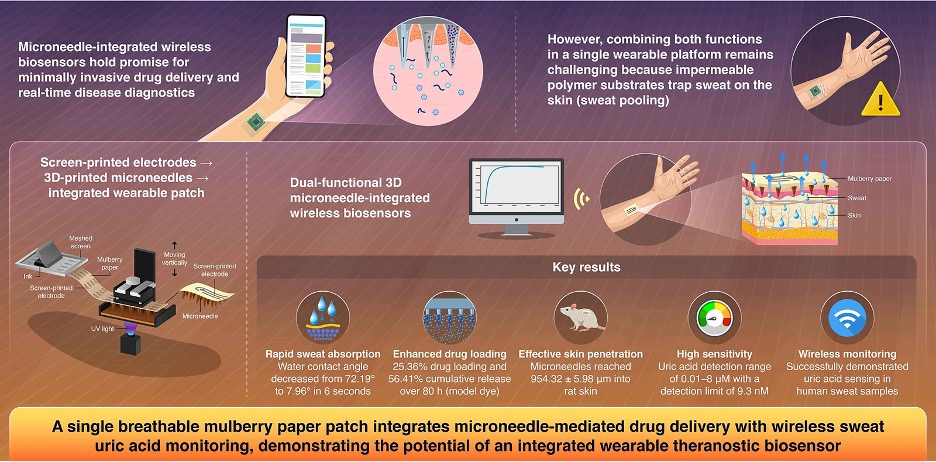
Researchers at South Korea’s Jeonbuk National University have developed an innovative breathable wearable patch combining 3D-printed microneedles and wireless uric acid sensing on traditional Korean mulberry paper. The patch demonstrated enhanced drug loading, highly sensitive uric acid detection, and efficient sweat management, addressing key limitations of conventional wearable devices. With drug delivery and sensing evaluated separately, this platform offers a promising foundation for future integrated treatment and real-time health monitoring, says a press release.
Conventional wearable health-monitoring patches often trap sweat and cause skin discomfort, highlighting the need for breathable materials. Addressing this challenge, researchers led by Professor Sooman Lim at Jeonbuk National University, South Korea, have developed a breathable wearable patch using traditional Korean mulberry paper, known as hanji. The platform combines 3D-printed microneedles for potential drug delivery with printed electrodes for wireless uric acid sensing. The study, published in Chemical Engineering Journal, demonstrates the feasibility of incorporating both functions into a single paper-based platform. This paper was made available online on June 3, 2026, and was published in Volume 542 of the journal on August 15, 2026, with Aqila Che Ab Rahman and Habibulla Imran contributing equally as authors.
"Conventional wearable patches often struggle to balance skin comfort with reliable sweat collection. By using breathable mulberry paper, we aimed to develop a platform that supports moisture transport while accommodating both microneedles and printed sensing electrodes," says Professor Sooman Lim of Jeonbuk National University.
Related Wearable Patch Aims To Detect Falls and Notify Families
Mulberry paper's porous network promotes moisture transport, with water contact angles dropping from 72.19° to 7.96° in six seconds to manage sweat accumulation.
Using light-based 3D printing, the team fabricated microneedles directly on the paper without adhesives. The optimized microneedles achieved a drug loading of 25.36%, compared with 12.6% for unmodified microneedles, and released 56.41% of the loaded model dye over 80 hours. They also penetrated approximately 954 micrometers into excised rat skin without structural deformation.
The printed electrochemical sensor detected uric acid across concentrations ranging from 0.01 to 8 micromolar, with a detection limit of 9.3 nanomolar. Tests using buffer and sweat samples yielded recoveries of 98.1%–101.3% that agreed with laboratory LC-MS analysis, demonstrating the sensor's analytical performance. Additionally, the sensor dries within 13 seconds, provides consistent readings across three uses, and operates on a low-power wireless system drawing just 15 mW.
Uric acid is a key marker for gout and hyperuricemia, making a sweat-based home-monitoring patch a convenient alternative to blood draws.
"Our findings demonstrate the potential of combining microneedle-based delivery and wireless sweat sensing on a single breathable substrate. Although we evaluated these functions separately, the results provide a foundation for future devices that could integrate treatment and real-time health monitoring," explains Professor Lim. Future work will involve testing the patch with clinical drugs, conducting skin-safety studies, and performing real-time on-body testing.