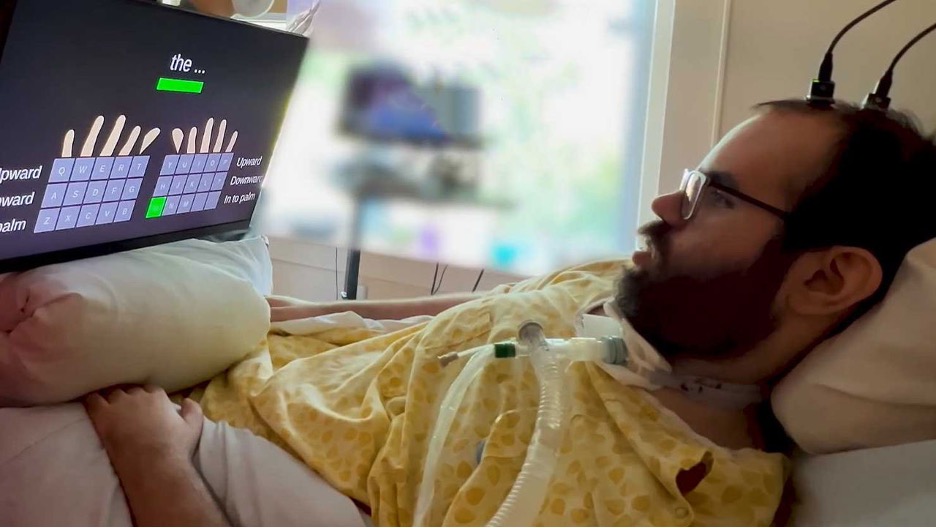
Loss of communication can be among the most devastating symptoms for patients with paralysis. A new study by investigators from Mass General Brigham Neuroscience Institute and Brown University describes an investigational implantable brain computer interface (iBCI) typing neuroprosthesis that can restore communication with speed and accuracy. The tool, which utilizes the QWERTY keyboard and attempted finger movements, performed well in two BrainGate clinical trial participants - one with amyotrophic lateral sclerosis (ALS) and the other with a cervical spinal cord injury. Their results are published in Nature Neuroscience.
“For many people with paralysis, when losing use of both the hands and the muscles of speech, communication can become difficult or impossible. Often, people with severe speech and motor impairments end up relying on things like eye-gaze technology – spelling words out one letter at a time by using an eye movement tracking system. Those systems take far too long for many users,” said senior author Daniel Rubin, MD, PhD, a critical care neurologist with the Center for Neurotechnology and Neurorecovery at Mass General Brigham Neuroscience Institute. “Patients often find this and other types of Augmentative and Alternative Communication systems frustrating to use. BCIs are on track to become an important new alternative to what’s currently offered.”
Communication devices for people with paralysis have been sub-optimal for many years. Patients often describe them as slow, error-prone, and difficult to use; some people abandon them altogether. This gap between what is available and what is needed inspires BrainGate - a team of neurologists, neuroscientists, engineers, computer scientists, neurosurgeons, mathematicians, and other researchers from multiple partner institutions working together to create better communication and mobility tools for people with neurologic disease, injury, or limb loss, Mass General Brigham said in a press release.
“Since 2004, our BrainGate team has been advancing and testing the feasibility and efficacy of implantable brain computer interfaces to restore communication and independence for people with paralysis,” said co-author Leigh Hochberg, MD, PhD, leader of the BrainGate clinical trial and director of the Center for Neurotechnology and Neurorecovery at Mass General Brigham Neuroscience Institute. “The BrainGate consortium demonstrates the strength of academic and university-based researchers working together, thinking about what’s possible, and then advancing the frontiers of restorative neurotechnology. And by doing so, we make it that much easier for industry to create the final form of implantable medical devices for our patients.”
Related Stamp-Sized Brain Implant Let Your Thoughts Talk to AI
The new BrainGate iBCI typing neuroprosthesis starts with microelectrode sensors placed in the motor cortex, a part of the brain that controls movement. Next, a QWERTY keyboard is displayed in front of the participant, with each letter mapped onto fingers and finger positions - up, down, or curled. As the participant intuitively attempts these finger movements, the electrodes sense the brain’s electrical activity, then send a signal to a computer system that can translate the neural activity into letters. This output is then processed through a final predictive language model to ensure a cohesive, accurate communication result.
Two clinical trial participants, one with advanced ALS and the other with a spinal cord injury, used this new iBCI typing neuroprosthesis to communicate rapidly and accurately. The participants calibrated their devices with as few as 30 sentences; one participant was able to reach a top typing speed of 110 characters or 22 words per minute, with a word error rate of 1.6%. That’s on par with able-bodied typing accuracy. What’s more, both participants used the device from the comfort of their own place of residence, demonstrating the potential for translation and at-home use in the future.
“Decoding these finger movements is also a big step toward being able to restore complex reach and grasp movements for people with upper extremity paralysis,” said first and corresponding author Justin Jude, PhD, a postdoctoral researcher at Mass General Brigham. “And there’s also room to make this communication tool better—like implementing a stenography or otherwise personalized keyboard to make typing even faster. Our BCI is a great example of how modern neuroscience and artificial intelligence technology can combine to create something capable of restoring communication and independence for people with paralysis.”